
Why Africa, Asia, and Latin America Can’t Fully Digitize Without Fixing Addressing First
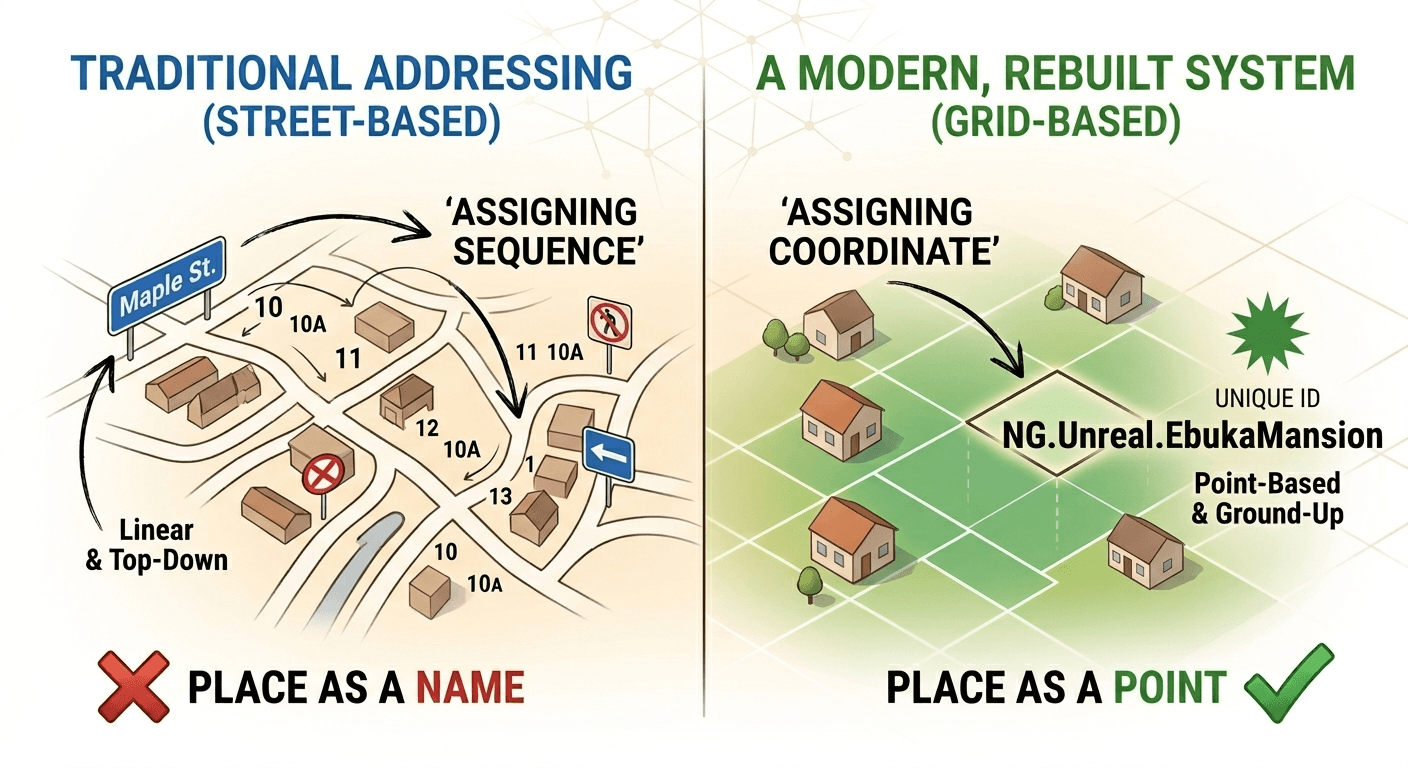
Without reliable addressing infrastructure, digitization risks reinforcing exclusion rather than resolving it.
Introduction: The Digitization Paradox
Across Africa, Asia, and Latin America, governments are investing heavily in digital transformation. National ID programs, e-government portals, and digital payment systems are expanding rapidly.
Yet many of these initiatives encounter persistent friction at the point of implementation. Citizens struggle to complete registrations. Service delivery stalls at verification steps. Databases fail to reconcile records.
A recurring but underexamined constraint is the absence of reliable address infrastructure.
Digital Public Infrastructure and Its Dependencies
Digital public infrastructure (DPI) frameworks—promoted by institutions such as the World Bank and the G20—emphasize foundational layers including digital identity, payments, and data exchange.
However, these systems rely implicitly on the ability to link individuals to physical households. Identity without location limits service targeting. Payments without verified residence complicate compliance.
Address systems function as connective tissue between digital identity and physical reality.
Case Patterns in Rapidly Urbanizing Regions
In many cities across the Global South, digitization initiatives must contend with:
Informal settlements lacking standardized numbering
High rates of residential mobility
Multi-family dwellings without formal subdivision
These conditions complicate efforts to integrate citizen data across ministries.
World Bank urban governance reports highlight the difficulty of aligning land records, population registries, and service delivery databases where address systems are incomplete.
Financial and Regulatory Implications
Banks and fintech providers operating in emerging markets must comply with international AML and KYC standards. Proof-of-address requirements become binding constraints when standardized addresses are unavailable.
This dynamic creates a paradox: digital finance expands rapidly, yet portions of the population remain excluded due to analog infrastructural gaps.
Address infrastructure thus becomes a precondition for sustainable digitization.
Why Sequencing Matters
Digitization strategies often prioritize visible outputs—mobile applications, online portals, biometric IDs. Address reform is slower, politically complex, and less visible.
However, sequencing matters. Building digital layers on unstable physical reference systems increases long-term costs and integration challenges.
A durable digital state requires durable locational reference.
Conclusion: Digitization Requires Physical Anchors
The promise of digital transformation is real. But digital systems do not float independently of physical reality.
Without reliable addressing infrastructure, digitization risks reinforcing exclusion rather than resolving it.
Reconsidering addressing as a foundational layer of digital modernization is therefore not a technical preference—it is a structural necessity.