
Why Renters Bear the Highest Cost of Address Insecurity
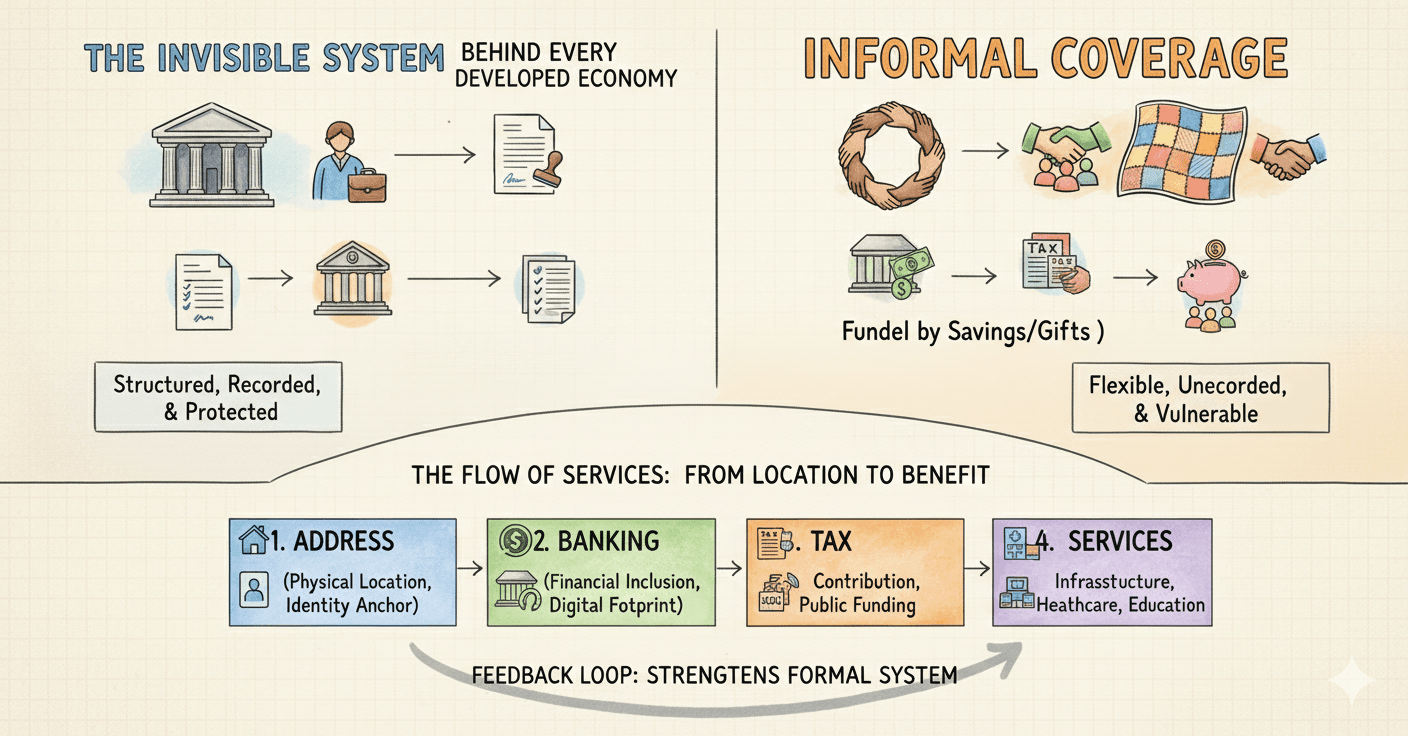
Urban housing policy often focuses on affordability, tenure, and supply. Addressing rarely enters the discussion. Yet for renters, stable and distinct locational recognition can determine access to credit, utilities, and public services.
Introduction: The Overlooked Majority in Urban Housing
In many of the world’s fastest-growing cities, renting is the dominant mode of housing. Young workers, migrants, and low-income families rely on rental markets for flexibility and access to opportunity. Yet rental households often face the greatest instability in how their place of residence is recognized.
Address systems are typically designed around plots, buildings, or streets—not around individual households within subdivided structures. As rental density increases, this design gap becomes more consequential.
The result is a structural asymmetry: property owners benefit from stable locational recognition, while renters operate with weaker institutional anchoring.
Address Stability and Economic Continuity
Institutions rely on continuity. Credit histories, utility records, tax filings, and social benefits assume that households can be consistently referenced over time.
Renters, particularly in informal or semi-formal markets, often experience:
Frequent residential moves
Shared or indistinct addresses
Lack of formal tenancy documentation
The World Bank’s Global Findex data shows that documentation barriers disproportionately affect lower-income households, many of whom are renters. When address records lack precision or continuity, renters face additional friction in accessing financial services.
Address insecurity thus becomes a hidden cost layered on top of housing precarity.
Multi-Household Structures and Administrative Ambiguity
In dense urban environments, multiple families may occupy a single structure without formal subdivision. Address systems that recognize only the building, not the household, create ambiguity.
This ambiguity affects:
Utility billing and service allocation
Emergency response differentiation
Census accuracy
Credit risk assessment
UN-Habitat has noted that informal subdivision complicates urban service provision and data collection. Addressing systems that do not distinguish households exacerbate these challenges.
Mobility and the Modern Labor Market
Labor markets increasingly demand geographic mobility. However, when address recognition does not follow individuals across moves—or when new residences lack standardized referencing—mobility carries administrative penalties.
Renters may lose continuity in:
Credit records
Insurance coverage
Educational enrollment documentation
This dynamic discourages formal engagement and increases reliance on informal coping mechanisms.
Equity Implications
Address insecurity disproportionately affects:
Youth entering labor markets
Migrants relocating for work
Women-headed households
Informal sector workers
These groups already face economic vulnerability. Weak address infrastructure compounds their exposure.
The OECD has linked housing precarity with broader patterns of inequality. Address insecurity represents an additional layer within that relationship.
Conclusion: Recognizing the Household Within the Building
Urban housing policy often focuses on affordability, tenure, and supply. Addressing rarely enters the discussion. Yet for renters, stable and distinct locational recognition can determine access to credit, utilities, and public services.
If addressing systems remain anchored primarily to streets and buildings rather than households, renters will continue to bear disproportionate costs.