
4 Billion People Live Without a Formal Address. That’s Not a Statistic—It’s an Economic Emergency
Treating address absence as a marginal issue underestimates its cumulative impact. At scale, it constrains financial inclusion, urban productivity, and state capacity.
Introduction: Beyond the Headline Number
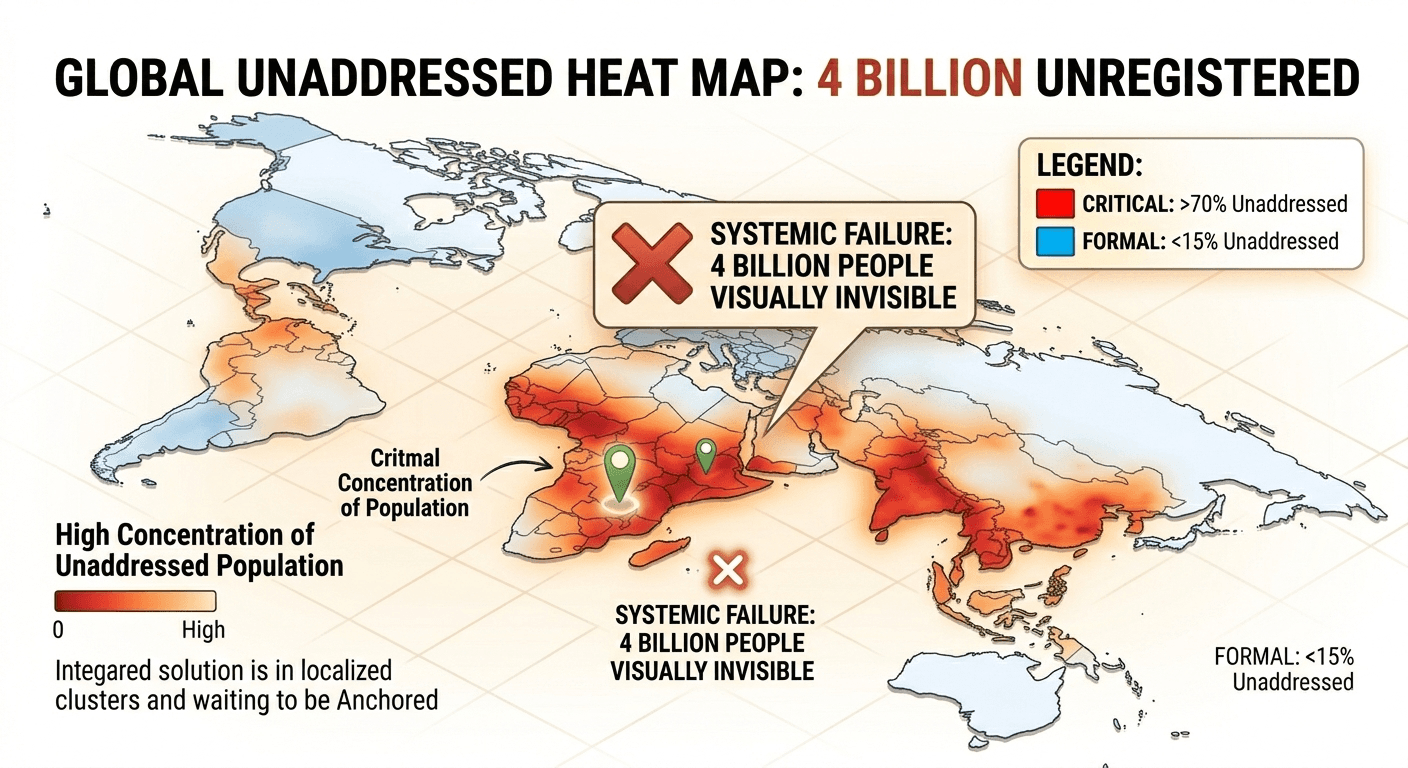
Estimates suggest that billions of people worldwide lack a formal, standardized address. The exact figure varies depending on methodology, but UN-Habitat and World Bank data consistently show that a substantial share of the global population lives in housing that is informally documented or not documented at all.
Such figures are often cited as development statistics. They should instead be understood as indicators of systemic economic constraint.
An address is not merely descriptive. It is a prerequisite for institutional participation.
Scale and Concentration
Urban growth is increasingly concentrated in regions where addressing infrastructure is weakest. The United Nations projects that nearly 90 percent of future urban population growth will occur in Africa and Asia (UN DESA, World Urbanization Prospects).
At the same time, informal housing dominates urban expansion in many cities. In these environments, the absence of standardized addresses is not an exception—it is the norm.
This concentration creates a compounding effect: as more economic activity moves into cities, more households operate without formal locational recognition.
The Household-Level Impact
Without a recognized address, households encounter barriers across multiple domains:
Opening bank accounts requiring proof of residence
Registering businesses
Accessing utilities and insurance
Enrolling in schools
Receiving deliveries
The World Bank’s Global Findex database identifies documentation requirements, including proof of residence, as a recurring obstacle to financial inclusion.
The economic cost is not abstract. It manifests as delayed access to credit, higher borrowing costs, and reduced ability to accumulate assets.
The Macroeconomic Consequence
When large portions of the population operate outside standardized address systems, the aggregate impact extends beyond households.
Governments struggle to target subsidies or collect taxes efficiently. Emergency response systems lack reliable locational reference. Public health campaigns encounter data gaps.
These inefficiencies translate into lower returns on infrastructure spending and slower productivity growth.
The scale of the issue warrants framing not as a local administrative gap, but as a structural constraint on global economic development.
Why the Emergency Is Underrecognized
Address absence rarely appears in macroeconomic indicators. GDP growth can occur despite weak addressing infrastructure, particularly in resource-driven economies.
However, as economies digitize and services formalize, the absence becomes more binding. Compliance requirements tighten. Service delivery becomes data-driven. The cost of invisibility increases.
What was once manageable friction becomes systemic exclusion.
Conclusion: From Statistic to Structural Reform
Treating address absence as a marginal issue underestimates its cumulative impact. At scale, it constrains financial inclusion, urban productivity, and state capacity.
Recognizing the issue as foundational reframes it from a technical challenge to a policy priority.