
Designing for Permanence: What Makes an Address System Future-Proof?
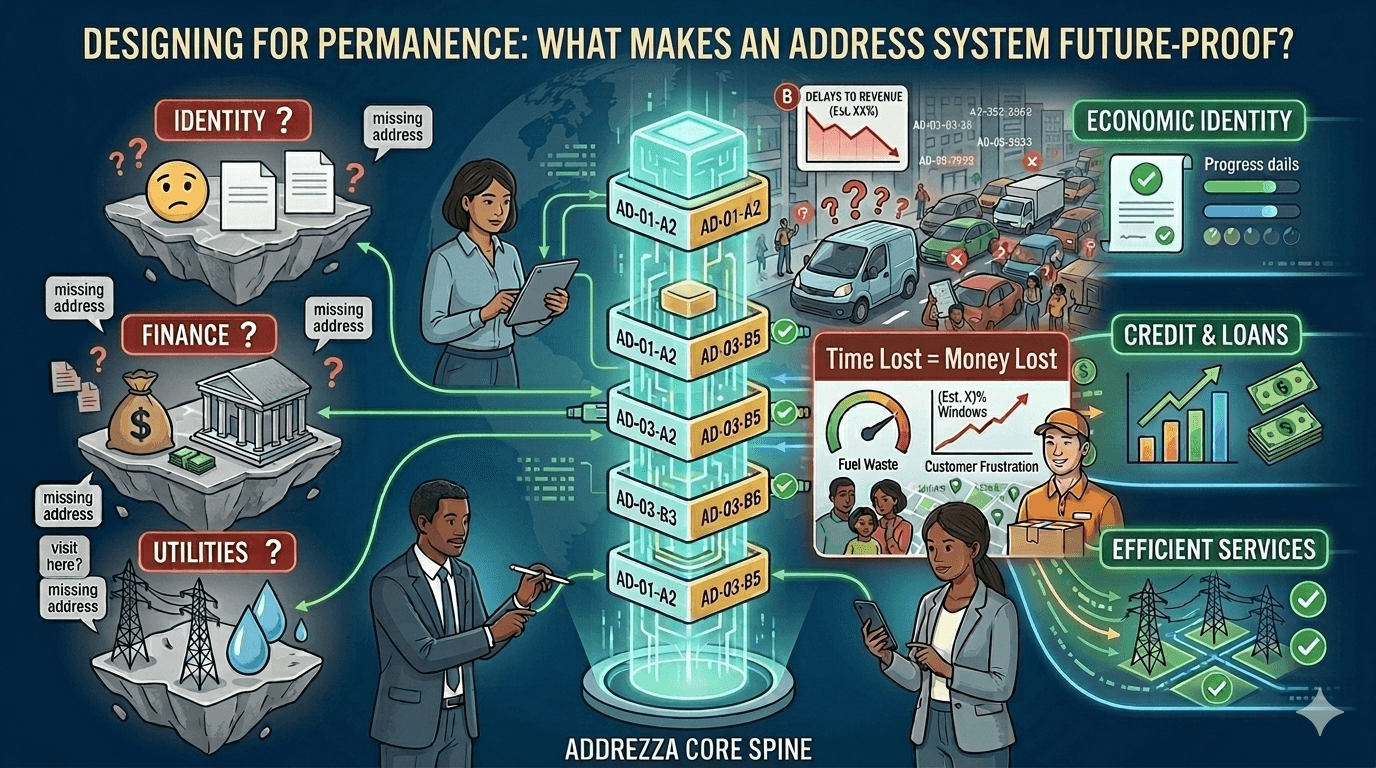
A future-proof address system ensures that as innovation accelerates, the spatial foundation of economic and administrative life remains stable.
Introduction: Infrastructure Must Outlive Innovation
Technology evolves rapidly.
Cities expand.
Buildings are demolished and rebuilt.
Transportation systems transform.
Digital platforms rise and fall.
Yet infrastructure must endure beyond technological cycles.
An address assigned today should remain meaningful decades from now—through demographic shifts, economic transitions, and digital transformations.
Future-proofing an address system means designing it not merely for current navigation needs, but for long-term administrative, economic, and technological relevance.
Permanence is not rigidity.
It is resilience.
Why Permanence Matters
Address systems underpin:
- Property records
- Taxation frameworks
- Utility services
- Financial accounts
- Emergency response
- Electoral rolls
Countries with stable addressing frameworks—such as the United States, Germany and Japan—benefit from decades of administrative continuity tied to consistent spatial referencing.
When permanence is absent, institutional memory fractures.
Future-proofing prevents that fragmentation.
Principle 1: Uniqueness Without Duplication
At its core, a future-proof address system must guarantee uniqueness.
No two distinct locations should share the same identifier within a jurisdiction.
- Duplication creates:
- Delivery errors
- Legal confusion
- Database mismatches
- Emergency response delays
Uniqueness requires standardized schema design, centralized governance, and strict validation rules.
In digital systems, even minor formatting differences can cause duplication across databases.
Future-proof systems anticipate scale and enforce structural consistency from the outset.
Principle 2: Persistence Across Time
Buildings change ownership.
Tenants move.
Neighborhoods evolve.
The address identifier itself should persist independently of occupant or usage or should it.
Persistence ensures:
- Longitudinal property records remain coherent.
- Credit histories tied to location retain integrity.
- Infrastructure maintenance records accumulate value.
Countries with mature cadastral systems, often supported by institutions such as the World Bank in developing contexts, emphasize separation between property ownership data and spatial identifiers.
A future-proof address does not dissolve when circumstances change.
It remains anchored to geography.
Principle 3: Scalability for Urban Growth
Urbanization continues to accelerate.
The United Nations projects sustained global urban growth in coming decades.
Future-proof systems must scale to accommodate:
- Vertical construction (multi-unit buildings)
- Informal settlement integration
- Subdivision of parcels
- Smart city expansion
Scalability requires flexible yet structured frameworks:
- Hierarchical numbering for multi-unit dwellings
- Modular expansion logic
- Geographic grid compatibility
A rigid system may function initially but fail under density pressure.
Design must anticipate tomorrow’s complexity.
Principle 4: Interoperability by Design
Address systems do not operate in isolation.
They must integrate with:
- Digital identity platforms
- Banking and fintech systems
- Insurance databases
- Utility management software
- E-commerce logistics platforms
Organizations such as the OECD emphasize interoperability as central to digital governance.
Future-proof addressing requires:
- Machine-readable formats
- API accessibility
- Open standards where appropriate
- Clear data governance policies
Interoperability reduces friction as new technologies emerge.
A system built for manual paperwork will struggle in a digital economy.
Principle 5: Human Usability
An address must serve both machines and people.
Overly complex alphanumeric strings may be efficient for databases but difficult for daily communication.
Conversely, purely descriptive formats may be intuitive but prone to ambiguity.
Future-proof design balances:
- Memorability
- Pronounceability
- Standardized formatting
- Cultural adaptability
Systems that citizens can confidently use are more likely to achieve widespread adoption and compliance.
Technological elegance must align with human behavior.
Principle 6: Legal Anchoring
Permanence requires legal recognition.
Without statutory backing:
- Address standards may fragment.
- Competing systems may emerge.
- Institutional adoption may lag.
- Legislation should clarify:
- Authority responsible for maintenance
- Standardization requirements
- Data sharing protocols
- Update procedures
Legal anchoring transforms addressing from a convenience into a component of public infrastructure.
Principle 7: Update Mechanisms Without Instability
While permanence is critical, adaptability is equally important.
Cities expand.
Roads are renamed.
Administrative boundaries shift.
Future-proof systems establish controlled update mechanisms:
Version tracking
Historical record retention
Clear transition protocols
For example, when municipalities consolidate—as seen periodically in countries like France—address frameworks must adapt without erasing historical continuity.
Stability and flexibility must coexist.
Principle 8: Resilience to Technological Change
Technologies evolve:
- Paper registries transitioned to digital databases.
- GPS enabled geocoding.
- Cloud computing transformed storage.
- AI now powers predictive logistics.
Future-proof address systems should be:
- Technology-agnostic in core structure
- Compatible with evolving geospatial standards
- Secure against cybersecurity risks
Reliance on proprietary, closed ecosystems may introduce vulnerability.
Open, standardized architecture enhances longevity.
Principle 9: Security and Privacy Safeguards
Precision must be balanced with protection.
Address systems connect individuals to physical space.
Future-proof design incorporates:
- Controlled data access layers
- Clear consent frameworks
- Encryption standards
- Audit mechanisms
Public trust determines adoption.
If address infrastructure becomes associated with misuse or surveillance fears, legitimacy erodes.
Durability depends on confidence.
Principle 10: Institutional Stewardship
No system sustains itself automatically.
Future-proofing requires:
- Dedicated governance bodies
- Continuous funding
- Professional data management
- Public-private coordination
In countries with mature land administration agencies, address systems are treated as ongoing public goods rather than one-time projects.
Institutional continuity protects structural continuity.
The Cost of Neglect
Address systems often receive limited attention until crisis emerges:
- Emergency dispatch failures
- Tax revenue gaps
- Rapid urban expansion
- Digital commerce bottlenecks
Retrofitting precision after years of fragmentation is costly.
Legacy inconsistencies multiply complexity.
Proactive design reduces long-term remediation expense.
Infrastructure built thoughtfully once is cheaper than repeated correction.
Designing for 2050 and Beyond
Future cities may include:
- Autonomous vehicle corridors
- Drone delivery networks
- Smart utility grids
- Climate-adaptive zoning
- Integrated digital twins
Each innovation depends on precise spatial referencing.
An address system designed solely for mail delivery will not meet the demands of automated logistics or AI-powered urban management.
Future-proofing requires anticipating integration with technologies not yet mainstream.
The address must become a stable coordinate within a dynamic ecosystem.
Permanence as Economic Strategy
Stable spatial identifiers support:
- Long-term property investment
- Intergenerational wealth transfer
- Credit market stability
- Infrastructure planning
Economic confidence grows when foundational systems endure.
Permanence reduces uncertainty.
Reduced uncertainty lowers risk premiums.
Lower risk encourages investment.
Future-proof addressing is therefore not merely administrative foresight—it is economic strategy.
Conclusion: Building for Continuity
Infrastructure shapes societies across generations.
Road networks outlast vehicles.
Power grids outlast appliances.
Legal frameworks outlast political cycles.
Address systems, though less visible, belong in the same category.
Designing for permanence means:
Ensuring uniqueness
Preserving persistence
Enabling scalability
Embedding interoperability
Anchoring legally
Governing responsibly
The future will introduce technologies we cannot yet predict.
But geography will remain constant.
A future-proof address system ensures that as innovation accelerates, the spatial foundation of economic and administrative life remains stable.
Because permanence, thoughtfully designed, is the quiet enabler of progress.