
The Invisible System Behind Every Developed Economy—And Why Billions Still Don’t Have It
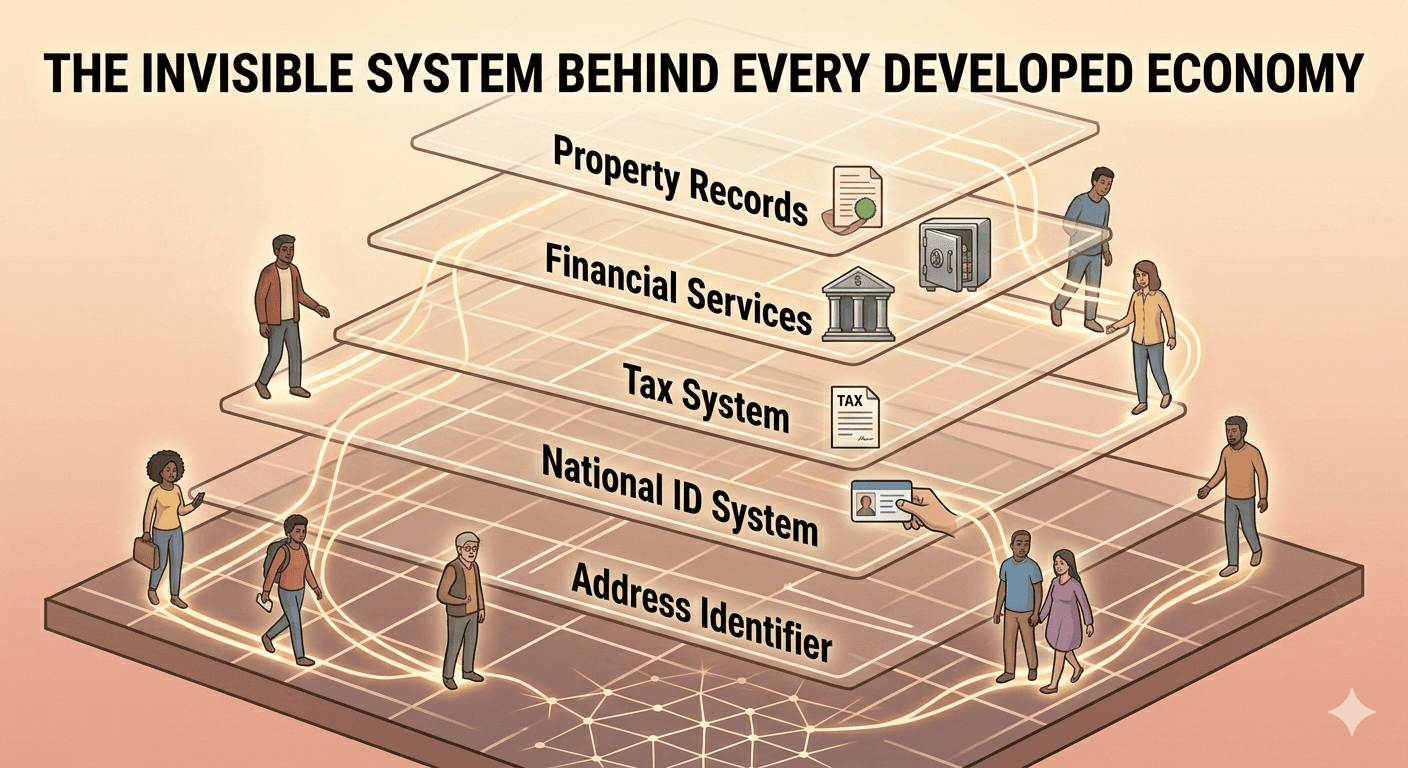
The most powerful infrastructure is often the least visible. Robust address systems underpin developed economies, yet remain incomplete across much of the world.
The Infrastructure Most People Never Notice
In high-income countries, most residents rarely think about their address. It is printed on identification cards, embedded in banking records, linked to tax files, and recognized across public and private institutions. It works quietly. Mail arrives. Utilities connect. Emergency services respond. Credit histories attach to households.
This quiet reliability creates an illusion: that address systems are natural byproducts of development rather than deliberate administrative infrastructure. In reality, robust address systems are the result of long-term state investment, legal standardization, and administrative maintenance.
Where such systems are weak or absent, the consequences are not merely logistical—they are structural. Billions of people live in environments where location cannot be consistently referenced across institutions. The result is not inconvenience, but exclusion.
Addressing as Administrative Infrastructure
Address systems function as coordination mechanisms. They allow governments to align population records with physical space. They enable taxation authorities to link economic activity to jurisdictions. They allow courts, utilities, and social services to operate predictably.
The OECD has repeatedly emphasized the importance of reliable administrative data in strengthening state capacity and fiscal governance (OECD Government at a Glance). Address data sits at the core of this administrative ecosystem.
In countries with mature systems, address registries are standardized, continuously updated, and interoperable across agencies. This level of integration did not emerge spontaneously; it evolved over decades of institutional refinement.
The Development Divide in Address Infrastructure
The contrast becomes clear in rapidly urbanizing regions. According to UN-Habitat, over one billion people live in informal settlements, often without standardized street names or building numbers. In these contexts, households may describe their location relative to landmarks, informal boundaries, or temporary markers.
While such systems function socially, they do not integrate easily into banking, taxation, or national registries. As a result, institutions rely on workarounds—letters from local authorities, utility bills, or affidavits—that are inconsistent and exclusionary.
The World Bank has noted that weak foundational registries, including address systems, constrain the effectiveness of broader digital government reforms (World Bank, Digital Government for Development). Without stable location referencing, administrative modernization stalls.
Why This Infrastructure Became Invisible
In developed economies, address systems became so reliable that they faded from policy discourse. Investment shifted toward visible infrastructure—roads, telecommunications, energy grids—while addressing was assumed to be “complete.”
This invisibility has policy consequences. Infrastructure debates rarely include addressing, despite its cross-sectoral role. Digital transformation programs prioritize connectivity and identity systems but often overlook the need for stable household referencing.
The absence of debate does not reflect irrelevance; it reflects normalization.
The Cost of Absence
Where addressing infrastructure is weak, transaction costs rise. Deliveries fail. Emergency services struggle. Tax bases shrink. Credit access narrows. The effects compound across sectors.
The International Monetary Fund has highlighted the link between administrative capacity and economic performance. While addressing is rarely isolated as a variable, its role in administrative coherence is implicit.
The global inequality in address infrastructure is therefore not symbolic. It shapes who can participate fully in modern economic systems.
Conclusion: Recognizing What Has Been Taken for Granted
The most powerful infrastructure is often the least visible. Robust address systems underpin developed economies, yet remain incomplete across much of the world.
Recognizing this gap is not about importing models wholesale. It is about acknowledging that economic inclusion depends not only on markets and connectivity, but on the quiet administrative systems that allow institutions to recognize people and households consistently.
Until that recognition becomes universal, development itself will remain uneven.