
Why Delivery Apps Should Care About Public Address Systems
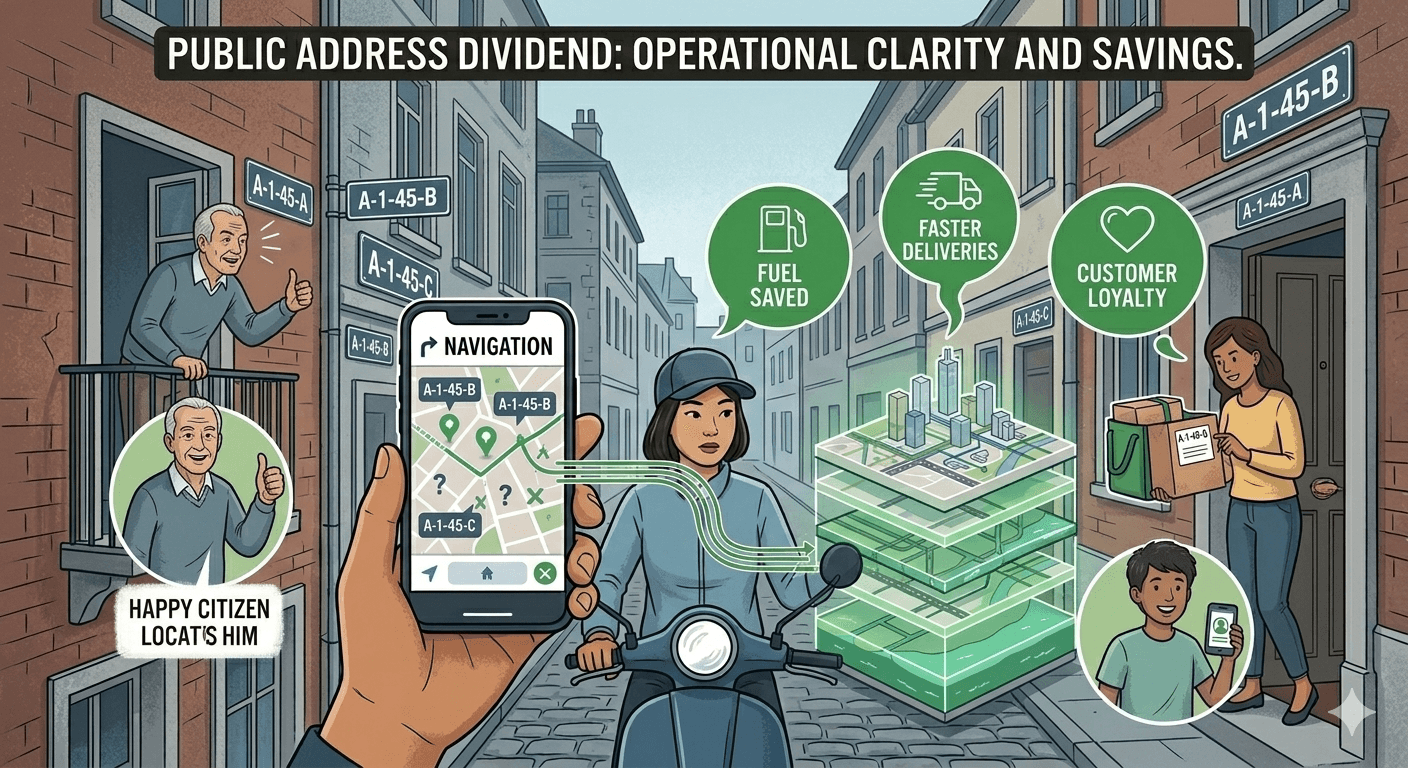
Delivery platforms—food, parcels, groceries—have expanded rapidly across both developed and emerging economies.
Introduction: Private Efficiency, Public Foundations
Delivery platforms—food, parcels, groceries—have expanded rapidly across both developed and emerging economies.
Their growth depends heavily on location accuracy.
Yet many operate in environments where public address systems are incomplete or inconsistent.
The Cost of Compensating
When public address infrastructure is weak, platforms compensate by:
- Building proprietary location databases
- Relying on customer-pinned map locations
- Using driver-generated notes
- Maintaining internal correction teams
These measures increase operational costs.
The World Economic Forum has emphasized how logistics inefficiencies constrain competitiveness in urban economies.
Weak public addressing externalizes costs onto private firms.
Data Fragmentation
When each platform builds its own workaround:
Address datasets become siloed
Interoperability declines
National standardization becomes harder
Instead of strengthening public systems, private optimization may unintentionally deepen fragmentation.
Scalability Constraints
As platforms expand into:
- Secondary cities
- Peri-urban zones
- Informal settlements
Inconsistent addressing increases friction.
Scaling requires predictable location frameworks.
Public-Private Alignment
Delivery platforms benefit from:
Standardized household identifiers
Machine-readable formats
Persistent, updated registries
Public address systems reduce redundancy and support innovation.
Conclusion: Shared Foundations
Delivery apps may innovate at the user interface level.
But their long-term scalability depends on foundational infrastructure.
Public address systems are part of that foundation.