
The Administrative Blind Spot in Emerging Economies
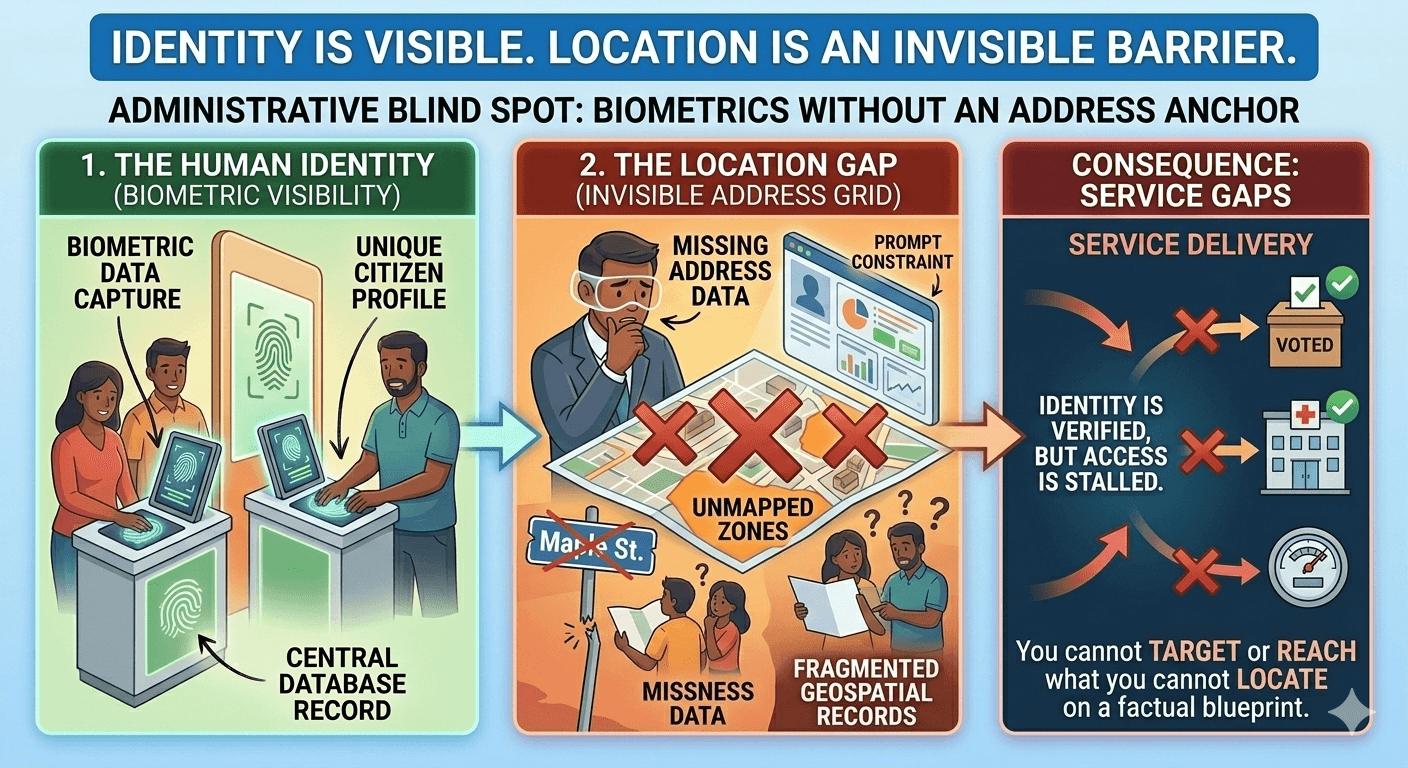
But without reliable address infrastructure, administrative systems operate with structural blind spots.
Introduction: Modern Systems, Incomplete Foundations
Across emerging economies, governments are investing in:
- Digital tax systems
- E-procurement platforms
- Online business registration
- Digital identity frameworks
Yet many of these systems rely on location data that remains fragmented or inconsistent.
The blind spot is not technological capacity. It is foundational location infrastructure.
Digitization Without Foundational Registries
The World Bank’s ID4D and digital government programs consistently emphasize the importance of foundational registries—identity, business, land, and address.
When address registries are incomplete:
Agencies build parallel location datasets
Interoperability declines
Data reconciliation costs increase
Each ministry may maintain its own interpretation of location records, creating duplication and inconsistency.
Fiscal Implications
Property taxation, utility billing, and business licensing depend on accurate location referencing.
Inconsistent addressing leads to:
- Under-collection of local taxes
- Informal economic activity remaining unregistered
- Difficulty enforcing compliance
OECD research on revenue mobilization highlights how administrative data quality affects tax capacity.
Address infrastructure influences fiscal capacity.
Planning Under Uncertainty
Urban planners rely on location-based data to forecast:
- Infrastructure demand
- School capacity
- Health facility distribution
- Transport needs
When household-level references are weak, projections are built on incomplete datasets.
The result is misallocation—either underbuilding or overbuilding in the wrong places.
Crisis Response Limitations
Public health campaigns, disaster response, and emergency relief require precise geographic targeting.
Ambiguous addressing reduces response speed and targeting accuracy.
The COVID-19 pandemic revealed how data gaps complicate targeted interventions in dense urban environments.
Conclusion: The Invisible Constraint
Emerging economies often pursue ambitious modernization agendas.
But without reliable address infrastructure, administrative systems operate with structural blind spots.
Digital transformation without location precision limits its own potential.