
The Cost of Ambiguity: How Inaccurate Addressing Erodes Economic Efficiency
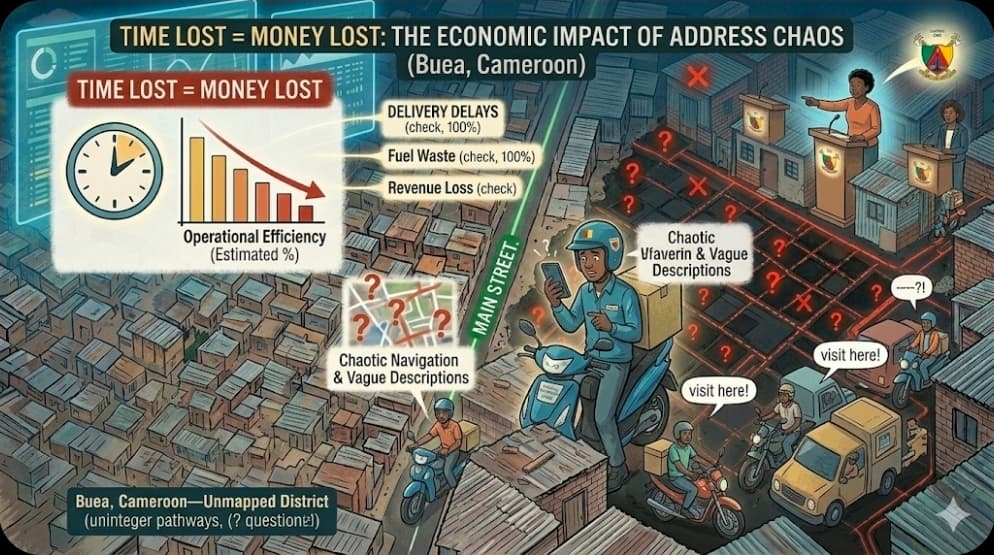
In an era where digital systems promise speed and automation, inconsistent addressing becomes increasingly costly.
Introduction: Ambiguity Is Expensive
In economics, friction has a cost.
A delayed shipment.
A misrouted ambulance.
A rejected loan application.
An undelivered utility bill.
These are not isolated inconveniences—they are signals of systemic inefficiency.
Address ambiguity—defined as the inability to precisely and consistently reference a physical location—is a significant, often overlooked, driver of economic inefficiency. Inaccurate, missing, or inconsistent addressing acts as a hidden tax, inflating operational costs, degrading productivity, and eroding trust in both commercial and institutional systems.
Efficiency depends on precision.
Ambiguity multiplies waste.
The Economic Impact of Poor Addressing
- Logistics and Operational Costs: Poor address data, including missing or incorrect information, costs businesses over $20 billion annually in undeliverable mail and packages. This results in increased expenses for shipping, labor for manual corrections, and the replacement of lost materials.
- Productivity Losses: Inaccurate addresses force employees to spend time manually verifying locations, resulting in wasted hours and decreased efficiency. In the broader enterprise, "work waste"—which includes searching for information—can lead to thousands of dollars in lost productivity per employee annually.
- E-commerce and Retail Impact: As shopping shifts online, invalid address data directly impacts profitability, causing failed deliveries, increased returns, and decreased customer satisfaction.
- Financial and Institutional Trust: Inaccuracy in data, such as the roughly 33% of prospect data in financial institutions that is considered inaccurate, leads to reduced trust, damaged reputation, and compliance issues.
When ambiguity exists:
- Drivers rely on phone calls for clarification.
- Parcels are delayed or returned.
- Fuel consumption increases.
- Customer satisfaction declines.
Even a small error rate—say 3–5% misdeliveries—can represent significant operational losses when multiplied across millions of shipments.
Precision is not merely a technical preference.
It is a cost-control strategy.
E-Commerce and Last-Mile Complexity
E-commerce growth has magnified the importance of last-mile delivery.
Companies like Amazon depend on highly granular address verification systems.
Last-mile delivery is often the most expensive segment of the logistics chain. Address inaccuracies amplify that cost by:
- Increasing re-delivery attempts
- Extending route duration
- Requiring manual verification teams
For emerging economies experiencing digital commerce expansion, address ambiguity can become a structural bottleneck to growth.
Efficiency gains in digital retail depend on physical precision.
Financial Services and Verification Overhead
Banks and financial institutions must verify customer addresses for compliance and risk management.
Inconsistent or ambiguous addresses increase:
- Onboarding time
- Compliance review workload
- Fraud detection complexity
- Reduce access to credit up to 40%
Institutions may compensate by requiring additional documentation, increasing both operational cost and customer friction.
According to reports by the World Bank, financial inclusion depends not only on access to accounts but also on reducing administrative barriers.
Address verification delays are often invisible to consumers—but they impose real economic costs.
Insurance and Risk Mispricing
Insurance relies heavily on geospatial accuracy.
Premium calculations incorporate:
- Flood zone exposure
- Crime statistics
- Infrastructure resilience
- Environmental risk
If address data is imprecise:
Risk pools may be inaccurately modeled.
Premiums may be inflated to hedge uncertainty.
Coverage may be denied in borderline cases.
Ambiguity increases risk perception.
Risk perception increases cost.
Thus, households in poorly standardized addressing systems may indirectly pay more for protection—or remain uninsured.
Public Administration and Revenue Leakage
Governments rely on accurate addresses for taxation and service delivery.
Ambiguous or duplicated addresses can result in:
- Missed tax assessments
- Utility billing inefficiencies
- Incomplete census counts
- Misallocation of subsidies
Organizations such as the OECD emphasize administrative efficiency as central to economic competitiveness.
When property or service records cannot be reliably matched to precise locations, fiscal capacity weakens.
Revenue leakage reduces investment in public goods.
The cost of ambiguity becomes collective.
Emergency Response and Human Cost
In emergency situations, ambiguity can have consequences beyond financial loss.
Ambiguous addresses slow response times for:
- Ambulances
- Fire services
- Disaster relief teams
In dense urban environments, unclear building numbering or inconsistent naming conventions introduce confusion.
Cities with standardized addressing frameworks—such as Tokyo or Berlin—demonstrate how structured systems support efficient emergency coordination.
While human safety is paramount, economic implications follow:
- Property damage increases with delayed response.
- Insurance claims escalate.
- Productivity declines due to prolonged recovery.
Ambiguity amplifies vulnerability.
Informal Economies and Opportunity Loss
In many regions, businesses operate in areas with inconsistent or informal addressing.
This creates barriers to:
- Supplier relationships
- Formal contracts
- Credit access
- Digital commerce participation
A small enterprise may be discoverable by word of mouth—but not reliably located by institutional partners.
Opportunity cost accumulates when potential customers, lenders, or collaborators cannot confidently reference a business location.
Ambiguity reduces visibility within formal markets—even if the business physically exists.
Data Quality and System Fragmentation
Address ambiguity often stems from fragmented data systems:
- Different formatting standards
- Inconsistent abbreviations
- Missing building identifiers
- Duplicate records
When institutions maintain separate databases without synchronization, inconsistencies multiply.
Data cleaning becomes an ongoing expense.
Companies may employ entire teams dedicated to resolving address mismatches between systems.
This represents labor that could otherwise be invested in innovation or expansion.
Ambiguity diverts resources.
Urban Growth and Scaling Challenges
Rapid urban expansion introduces complexity:
- New subdivisions
- Informal settlements
- Vertical construction
- Multi-unit conversions
If addressing systems do not scale alongside growth, ambiguity spreads.
Urban planning agencies may struggle to:
- Accurately forecast infrastructure demand
- Coordinate transportation networks
- Map utility expansion
As cities scale, the cost of correcting legacy ambiguity increases.
Retrofitting precision is more expensive than building it early.
Macroeconomic Implications
While individual inefficiencies appear minor, aggregated ambiguity can influence macroeconomic performance.
Consider:
- Increased fuel imports due to inefficient routing
- Higher insurance premiums reducing disposable income
- Slower loan processing dampening investment
- Tax undercollection limiting infrastructure spending
The cumulative effect is reduced productivity.
Productivity drives GDP growth.
Ambiguity undermines productivity.
Thus, addressing precision contributes indirectly to national competitiveness.
The Hidden Cost Curve
Ambiguity often persists because its costs are diffuse and incremental.
No single incident justifies major reform.
But as digitalization deepens—e-commerce, fintech, smart grids, climate monitoring—the marginal cost of ambiguity rises.
Precision becomes more valuable over time.
The cost curve shifts from manageable inconvenience to structural inefficiency.
Economies transitioning toward digital systems experience this shift most acutely.
Toward Precision as Policy
Reducing ambiguity requires:
- Standardized national addressing frameworks
- Clear governance and ownership of address databases
- Interoperable data standards across institutions
- Regular updating and auditing mechanisms
- Integration with digital identity and property systems
Address precision should be treated as infrastructure investment—not administrative housekeeping.
Like roads or broadband networks, its benefits compound.
Conclusion: Clarity Compounds
Ambiguity is rarely dramatic. It is incremental.
A few minutes lost here.
A duplicated record there.
A misdelivered parcel.
A delayed verification.
Yet across millions of transactions, ambiguity becomes expensive.
Economic efficiency depends on reducing friction.
Friction often begins with uncertainty about place.
In an era where digital systems promise speed and automation, inconsistent addressing becomes increasingly costly.
Precision reduces transaction costs.
Reduced costs increase productivity.
Productivity drives prosperity.
The cost of ambiguity is rarely visible in headlines.
But in aggregate, it shapes the trajectory of economic growth.