
The Administrative Backbone of Prosperity: Address Systems as Digital Public Infrastructure
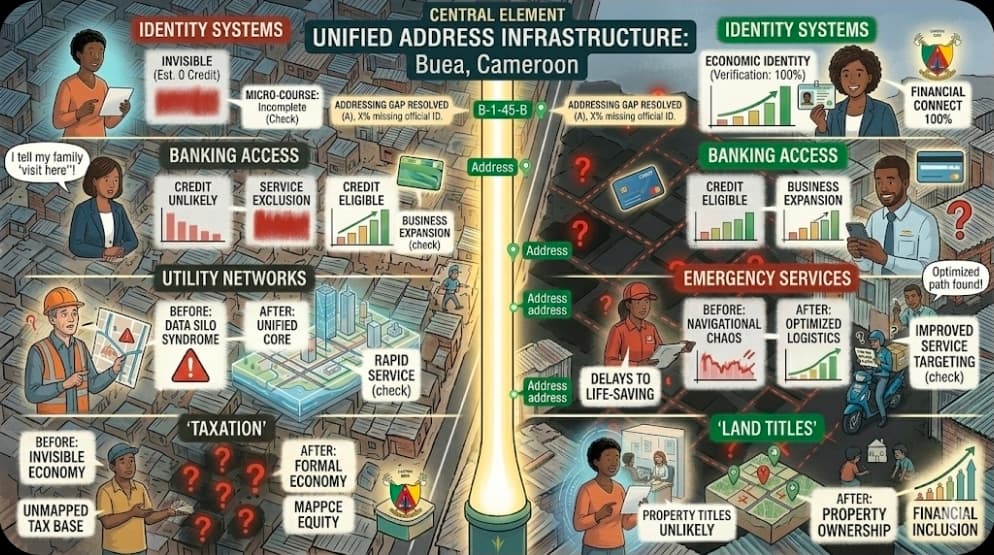
In an increasingly digital economy, prosperity depends not only on connectivity—but on precision.
Introduction: Infrastructure You Rarely See
When governments discuss infrastructure, they typically reference:
- Roads
- Bridges
- Ports
- Power grids
- Water systems
These are visible, tangible, and politically salient.
"Yet modern economies depend just as heavily on invisible infrastructure—systems that organize information, enable coordination, and anchor institutional trust."
Digital public infrastructure (DPI) has emerged as a defining framework for this invisible layer. Identity systems, payment rails, and data exchanges form its core.
But beneath these components lies an often underappreciated yet economically defining foundation:
Address systems.
Address infrastructure quietly connects people, property, services, and markets. Without it, the administrative state weakens. With it, prosperity becomes more scalable and inclusive.
What Is Digital Public Infrastructure?
Digital Public Infrastructure (DPI) refers to secure, inclusive, and interoperable digital systems—such as digital ID, payment, and data exchange platforms—that act as foundational, open-source building blocks for public and private services forming the backbone of modern societies. Designed for public benefit, DPI enables secure and seamless interactions between people, organizations, and governments- boosting economic opportunity, financial inclusion, and government efficiency.
Commonly cited pillars include:
- Digital identity (e.g., Aadhaar),
- Digital payments (e.g., UPI, Pix)
- Data exchange frameworks
Countries such as India have gained attention for integrated identity and payments architecture. India’s Aadhaar demonstrates how identity can serve as a base layer for service delivery and financial inclusion.
But identity answers the question: Who are you?
Payments answer: How do you transact?
Address infrastructure answers: Where are you anchored?
"Without a reliable answer to the “where,” identity and payments lose contextual grounding." ~ Ndamo Ndamo (Founder/Visionary at Addrezza)
Address Systems as a Foundational Layer
An effective address system performs several functions simultaneously:
- Unique identification of locations
- Standardized formatting across institutions
- Persistent reference over time
- Interoperability with digital systems
When addresses are inconsistent, duplicative, or non-standardized, institutional friction increases.
Address systems are not merely navigation tools—they are administrative reference frameworks.
They connect:
- Identity records
- Property registries
- Tax databases
- Utility billing systems
- Emergency services
- Financial accounts
They serve as the spatial index of the state.
Economic Scaling Requires Administrative Precision
Prosperity scales when coordination scales.
As populations urbanize and digital services expand, administrative complexity multiplies.
Consider:
- E-commerce growth
- Insurance underwriting
- Climate risk modeling
- Utility grid management
- Municipal tax collection
Each relies on precise, standardized location referencing.
Organizations such as the World Bank have emphasized that strong public administration correlates with improved development outcomes.
Administrative strength depends on foundational data infrastructure.
Address systems enable that precision.
Address Systems as Administrative Frameworks
- Reference Infrastructure: Unlike visible, physical features like roads, address systems act as a, structured, foundational framework that allows governments to manage, monitor, and regulate parcels and buildings.
- "Search Engine for Reality": Addresses are used to unlock, index, and organize other non-spatial data, allowing for the linking of disparate datasets (e.g., combining a person with a specific tax record, service, or utility account).
- Target of Management: The address is the minimum unit for municipal or national government management (parcel or building).
- Core Administrative Functions: Beyond navigation, they are vital for:
- Revenue Collection: Managing land rates and tax systems.
- Public Service Delivery: Facilitating emergency services (police, fire), postal services, and social services.
- Urban Planning: Monitoring, controlling, and planning urban growth.
- Read more...
Emergency Services and Public Safety
Beyond markets, address infrastructure underpins public safety.
Emergency response depends on:
- Accurate location dispatch
- Clear building identification
- Standardized routing
In contexts where addresses are ambiguous, response times increase - fatality rate increase.
Cities such as New York City and London rely on highly standardized addressing frameworks to coordinate police, fire, and medical services.
The value of this infrastructure becomes most visible during crisis—yet its maintenance requires long-term planning and standardization.
Taxation and Fiscal Capacity
Fiscal capacity determines a government’s ability to invest in infrastructure, education, and healthcare.
Property taxes, utility levies, and service fees depend on accurate address linkage.
If properties cannot be uniquely and persistently identified:
- Tax collection becomes inconsistent
- Revenue leakage increases
- Public investment capacity declines
The OECD has repeatedly highlighted the importance of reliable administrative data in strengthening fiscal systems.
Address systems contribute directly to that reliability.
They enable governments to map service delivery to revenue generation.
Urban Planning and Resource Allocation
Urban growth requires anticipatory planning.
City authorities must forecast:
- School capacity
- Transportation corridors
- Water demand
- Waste management needs
Granular location data supports these projections.
When addressing systems are fragmented or incomplete:
- Density estimates become unreliable
- Infrastructure investments lag
- Informal settlements expand without integration
UN agencies such as UN-Habitat emphasize spatial planning as central to sustainable urbanization.
Address infrastructure is a prerequisite for effective planning.
Financial Inclusion and Address Portability
In modern economies, individuals frequently move—between neighborhoods, cities, or rental units.
A resilient address system must accommodate mobility while preserving continuity.
Persistent, portable addressing reduces friction in:
- Bank account updates
- Insurance renewals
- Subscription services
- Government benefits
When address changes require repeated manual verification, participation costs rise.
Address infrastructure designed for portability enhances economic dynamism.
Interoperability: The Critical Feature
Digital public infrastructure functions best when systems interoperate.
Identity systems must integrate with payments.
Payments must integrate with taxation.
Taxation must integrate with property records.
Address infrastructure must connect all of them.
Interoperability requires:
- Standardized schemas
- Machine-readable formats
- API compatibility
- Governance frameworks
Without technical alignment, address data becomes siloed, undermining efficiency gains.
Prosperity depends not only on infrastructure existence, but on its coherence.
The Private Sector Multiplier
Private enterprises also depend on address systems:
- Logistics companies optimize delivery routes.
- Telecommunications providers deploy fiber networks.
- Energy utilities manage grid connections.
- E-commerce platforms validate shipping locations.
Companies such as Amazon and DHL rely heavily on standardized location data for operational efficiency.
When address infrastructure improves, private sector productivity rises.
The result is a multiplier effect: public investment in administrative infrastructure catalyzes private innovation.
Address Systems as Public Goods
House address systems function as a critical public good by providing non-excludable and non-rivalrous infrastructure, essential for the functioning of modern society, emergency services, and economic activity. As a public good, they are typically managed, maintained, and regulated by the government to ensure universal access.
Address infrastructure exhibits both qualities.
Key Aspects of Address Systems as a Public Good:
- Non-Excludable and Non-Rivalrous: Once an address system is in place, it is difficult to stop anyone from using it (non-excludable), and one person’s use of an address does not reduce the ability of others to use it (non-rivalrous).
- Infrastructure for Public Services: Similar to other public infrastructure, a systematic addressing system is foundational for public safety, enabling emergency services (police, fire, ambulance) to locate residences quickly.
- Economic and Social Integration: Reliable addressing is crucial for mail delivery, utility billing, and formal identification, allowing residents to access essential services and participate in the economy.
- Government Responsibility: Because address systems are foundational infrastructure, the government is responsible for their regulation and maintenance, ensuring they are accessible to all.
Once standardized and integrated:
- Multiple institutions benefit simultaneously
- Marginal cost of additional usage declines
- Network effects strengthen over time
Like roads or broadband networks, address systems require upfront coordination and governance—but deliver long-term economic dividends.
Governance and Maintenance
Effective address systems require:
- Legal frameworks defining standards
- Institutional ownership and accountability
- Continuous updating mechanisms
- Public-private coordination
Without governance clarity, fragmentation emerges.
Successful digital public infrastructure depends as much on institutional stewardship as on technical architecture.
Address systems must be treated as living infrastructure—maintained, audited, and modernized.
Prosperity Requires Foundations
Prosperity often appears driven by innovation, entrepreneurship, and investment.
Yet beneath these visible drivers lies a quieter architecture:
- Identity
- Payments
- Property records
- Address systems
When these foundations are coherent, opportunity scales.
When they fragment, friction multiplies.
Address systems form the spatial backbone of administrative coherence.
They connect individuals to institutions, markets to geography, and services to households.
In an increasingly digital economy, prosperity depends not only on connectivity—but on precision.
And precision begins with knowing, clearly and consistently, where participation is anchored.