
When a Street Name Is Not a System
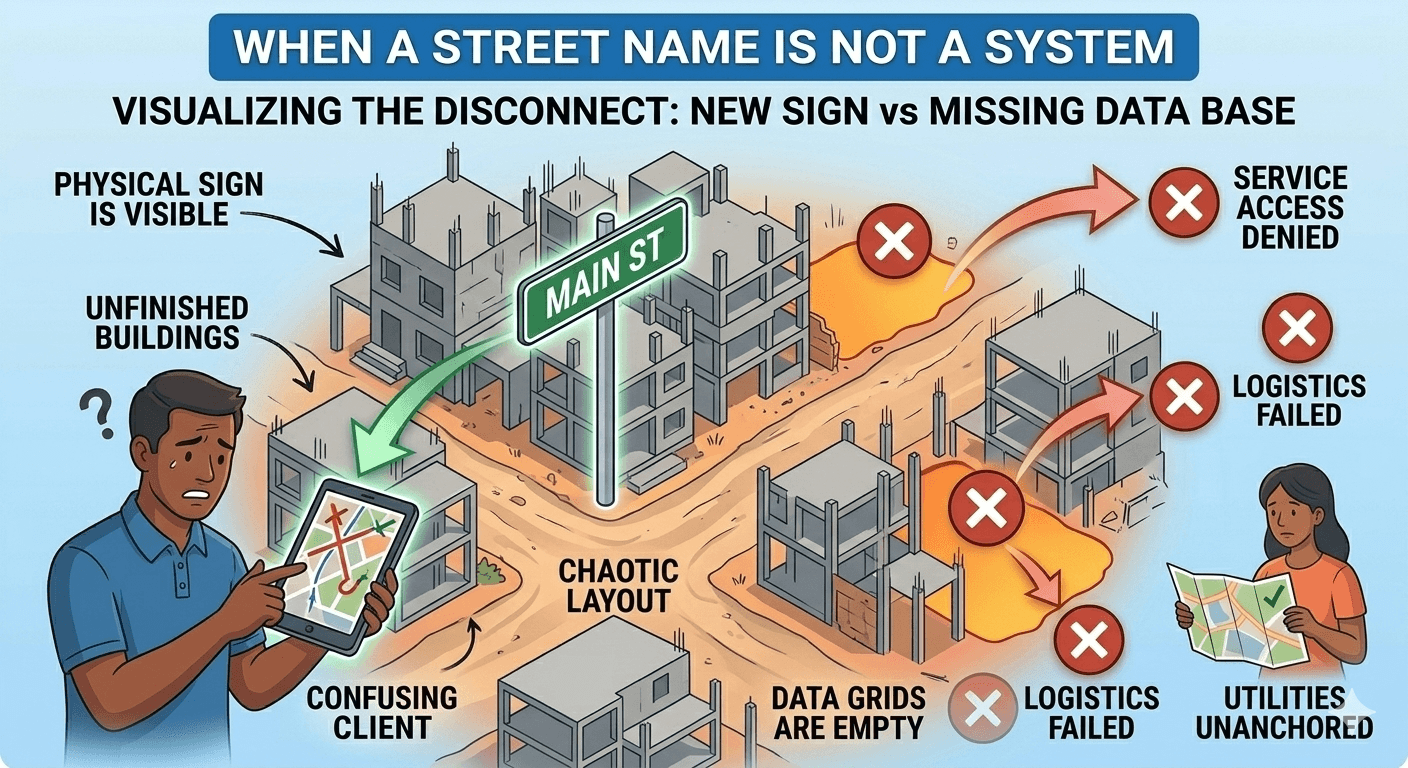
Without structured numbering, registry integration, and institutional alignment, a street name remains a label—not infrastructure.
Introduction: The Illusion of Completion
Many cities believe they have “solved” addressing once streets are named and signs are installed.
But a street name alone does not constitute an address system.
An address system requires:
- Structured numbering logic
- Registry integration
- Maintenance protocols
- Institutional adoption
Without these elements, street naming is symbolic rather than systemic.
Naming vs Numbering
Street naming is a visible political act. It can honor history, culture, or national figures.
Numbering, however, requires:
- Spatial planning
- Plot demarcation
- Sequential logic
- Administrative enforcement
The two are often implemented separately, leading to mismatched or inconsistent records.
Registry Disconnect
If newly named streets are not synchronized with:
- Land registries
- Utility databases
- Tax records
- Emergency services systems
Then each agency updates its records independently—or not at all.
The result is parallel databases referencing the same geography differently.
The World Bank’s digital governance frameworks repeatedly emphasize registry interoperability as a core requirement for modernization.
Urban Expansion and Maintenance Failure
Rapid urban growth creates:
- New streets outside formal planning grids
- Informal pathways becoming de facto roads
- Subdivisions without official approval
If maintenance mechanisms are weak, address systems degrade quickly.
An address system is not a one-time installation—it is ongoing infrastructure.
Institutional Adoption
Even well-designed address systems fail if:
Banks do not recognize them
Telecom companies do not integrate them
Courts and regulators do not enforce them
Adoption across institutions is what transforms signage into system.
Conclusion: Beyond Symbolism
Street signs create visibility.
Systems create functionality.
Without structured numbering, registry integration, and institutional alignment, a street name remains a label—not infrastructure.