
From Village Names to Digital Records: The Transition No One Designed
Until that transition is deliberately addressed, digital inclusion efforts will continue to encounter structural friction rooted not in technology, but in location referencing.
Introduction: Two Systems Colliding
For centuries, communities have relied on relational and descriptive methods to identify place. Directions referenced landmarks, family names, natural features, or social memory. These systems were adaptive and locally intelligible.
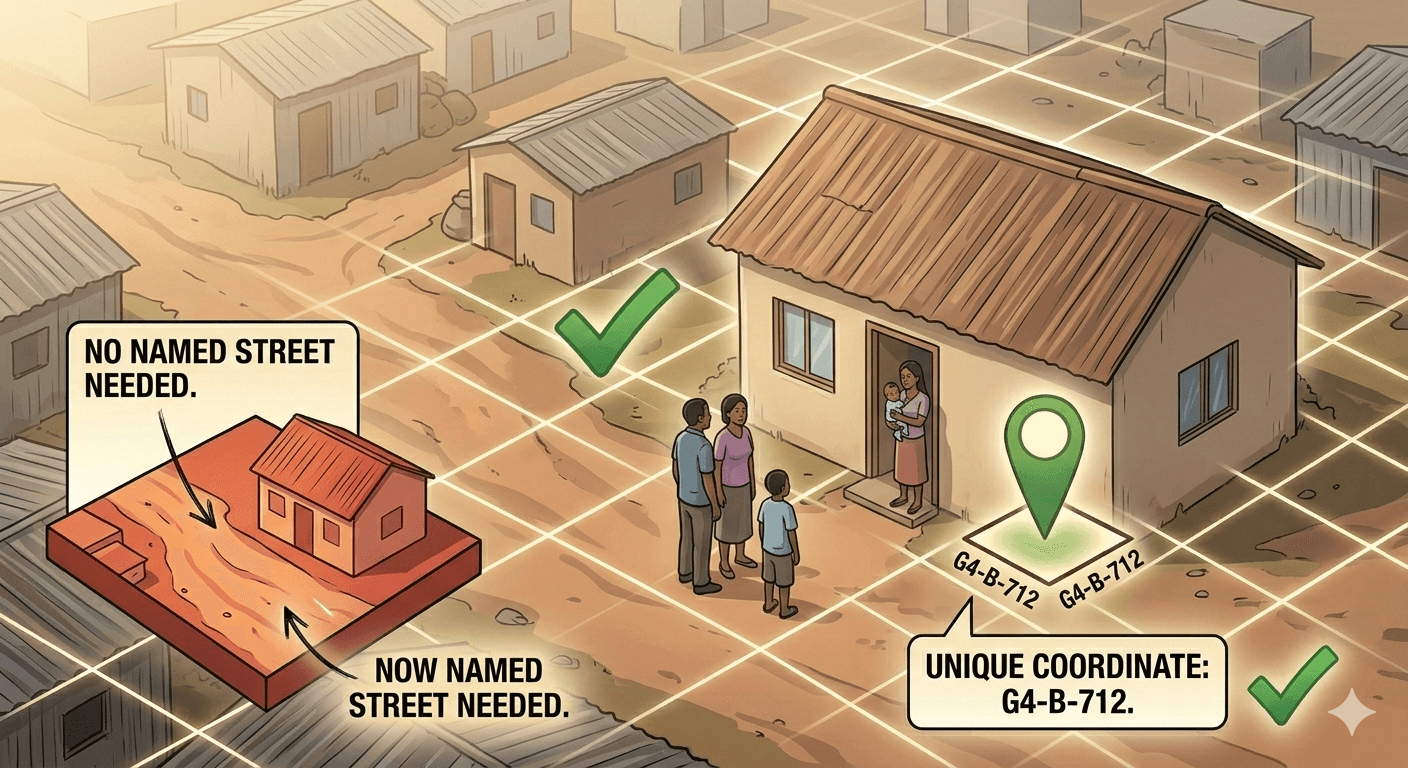
Digital economies, however, require standardized, machine-readable records. As societies transition from oral and relational location systems to digital administrative ones, a structural gap has emerged.
This transition was not deliberately designed; it unfolded implicitly as governments digitized records and institutions formalized requirements.
Oral Legibility vs Institutional Legibility
James C. Scott’s concept of “legibility” describes how states simplify complex realities to administer them effectively. Traditional village-based location systems were socially legible but not administratively standardized.
Digital systems demand:
Consistency
Interoperability
Persistence
Relational descriptions do not translate easily into databases. As a result, individuals transitioning from rural to urban environments often find that their locational identity does not meet institutional criteria.
Urban Migration and Documentation Gaps
The United Nations projects that urban populations will continue to grow rapidly in Africa and Asia. Migrants moving from villages to cities may enter housing arrangements that lack formal documentation.
Without standardized addresses, migrants encounter barriers in:
Bank account opening
SIM registration
Utility access
School enrollment
The World Bank has documented documentation barriers as a recurring issue in financial inclusion efforts.
Digitization Without Design
Governments across the Global South are investing in digital identity and service platforms. However, digitization often assumes the prior existence of stable locational records.
Where those records are incomplete or inconsistent, systems must rely on provisional workarounds.
The absence of a designed transition from relational to standardized addressing creates long-term data fragmentation.
Cultural Continuity vs Administrative Necessity
Reforming addressing systems does not require erasing traditional location practices. However, it does require recognizing that digital administration operates under different constraints.
The challenge lies not in replacing social systems, but in designing institutional systems that can reliably interface with them.
Conclusion: Designing the Bridge
The movement from village-based legibility to digital record systems is one of the least examined infrastructural transitions of the modern era.
Until that transition is deliberately addressed, digital inclusion efforts will continue to encounter structural friction rooted not in technology, but in location referencing.