
Why Mapping the World Did Not Solve Addressing It
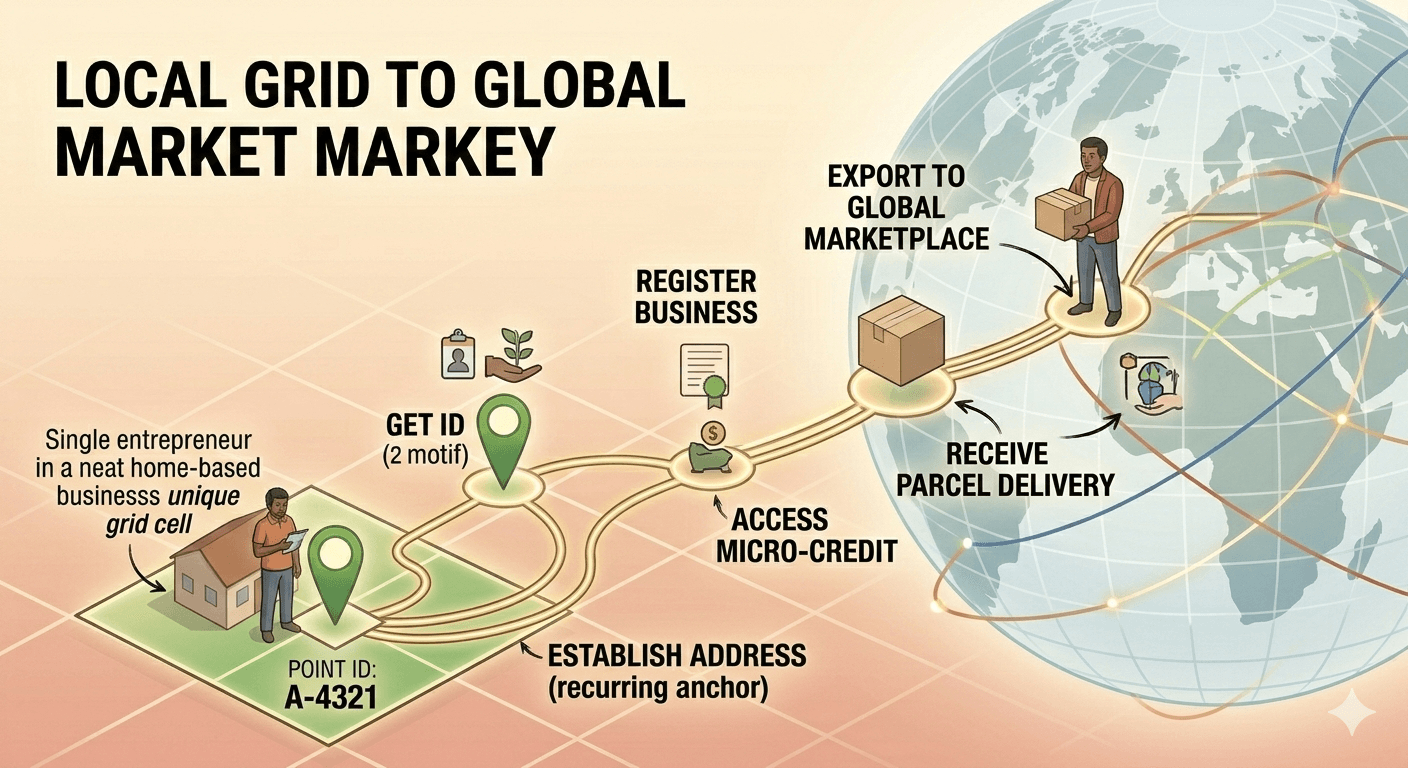
Addressing is not a cartographic problem alone. It is an administrative and economic one.
Introduction: The Mapping Assumption
Over the past two decades, global mapping initiatives have achieved near-universal spatial coverage. Satellite imagery, digital maps, and navigation tools have rendered much of the world visible from above.
This progress led to an implicit assumption: once mapped, places are addressed.
The reality is more complex.
Spatial Visibility vs Administrative Reference
Mapping provides coordinates and visual context. Addressing provides institutional reference.
A coordinate identifies a point in space. An address identifies a location within a legal, administrative, and economic framework.
Without integration into registries, property records, and service databases, mapped locations remain disconnected from institutional processes.
Why Precision Is Not Persistence
Geospatial data can change frequently as imagery updates. Administrative records require persistence over time.
A household’s economic identity depends on continuity. Credit histories, tax records, and service eligibility rely on stable referencing.
World Bank research on digital government emphasizes the importance of foundational registries for interoperability. Mapping alone does not create those registries.
The Limits of Technological Substitution
Technological solutions often promise to bypass legacy systems. However, substituting spatial precision for administrative integration overlooks the governance dimension of addressing.
Effective address systems require:
Standardization
Legal recognition
Institutional adoption
Ongoing maintenance
These are governance functions, not purely technical ones.
Case Patterns Across Regions
In multiple countries, high-resolution maps coexist with:
Delivery inefficiencies
Incomplete census data
Financial exclusion linked to proof-of-address requirements
This coexistence underscores that mapping is necessary but insufficient.
Conclusion: Beyond Visibility
Mapping the world has improved navigation and spatial awareness. It has not resolved the deeper question of how institutions reference households consistently.
Addressing is not a cartographic problem alone. It is an administrative and economic one.