
Addressing Inequality Is Infrastructure Inequality
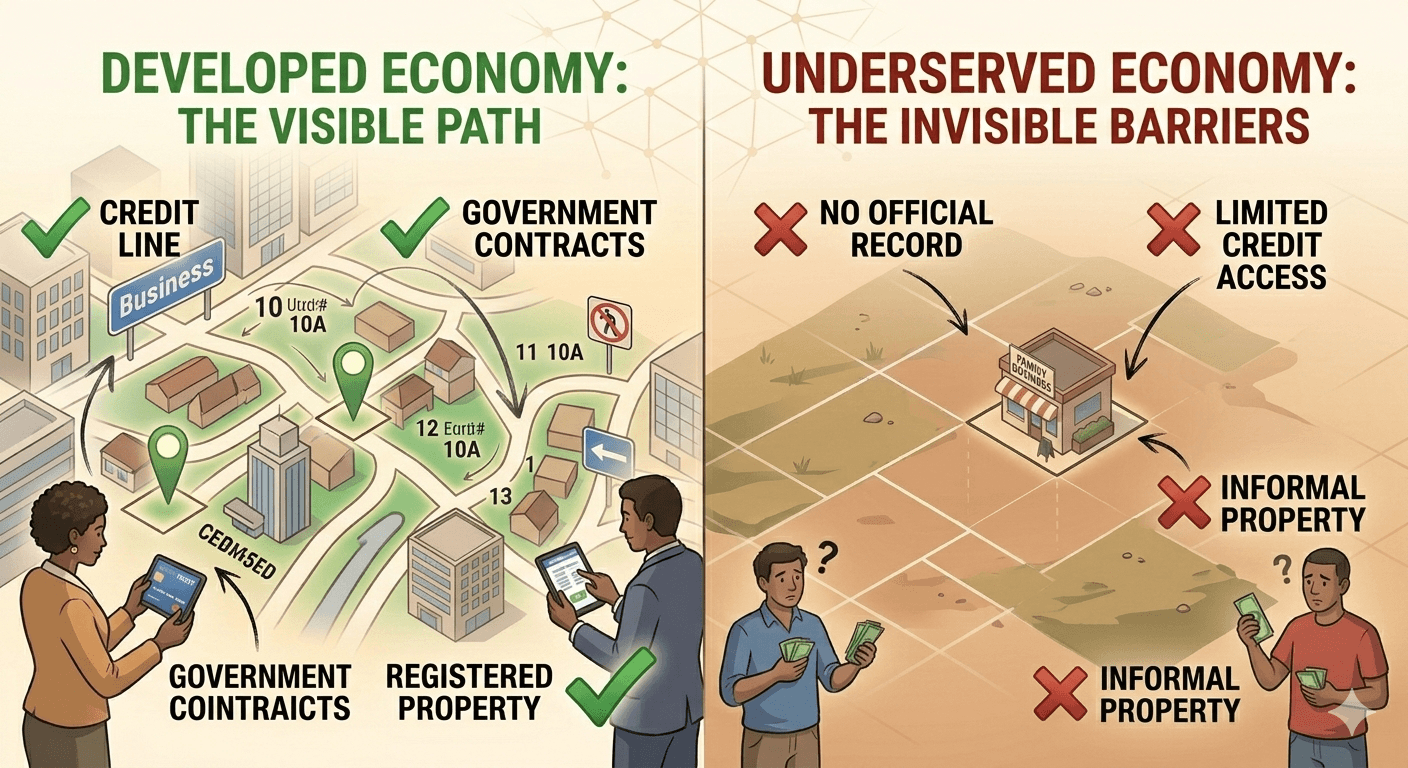
Addressing rarely appears in headlines. It is not politically visible like highways or bridges. Yet it underpins every transaction tied to physical location.
Introduction: Unequal Infrastructure, Unequal Outcomes
Infrastructure inequality is visible in roads, electricity access, and broadband connectivity. It is less visible in addressing systems.
Yet location recognition determines access to:
Credit
Capital
Insurance
Delivery services
Emergency response
Public benefits
Access to opportunities
And much more
When address systems function unevenly across neighborhoods, inequality becomes institutionalized.
Formal Areas vs Informal Areas
In formal urban districts:
Street names are standardized
Buildings are numbered
Municipal registries are updated
In informal or rapidly expanding areas:
Naming may be inconsistent
Numbering may be absent
Records may be incomplete
The World Bank has documented how informality correlates with reduced financial inclusion and service access.
Addressing gaps are one mechanism within that correlation.
Administrative Friction as a Barrier
When proof of address is required for:
Opening a bank account
Registering a business
Obtaining a SIM card
Accessing government transfers
Residents of poorly addressed areas face disproportionate friction.
Friction translates into time costs, informal workarounds, or exclusion.
Spatial Inequality in Data
Governments rely on data to allocate resources. If certain neighborhoods are poorly referenced:
Census accuracy declines
Service demand is undercounted
Investment decisions skew toward visible areas
OECD studies on regional inequality highlight how data visibility influences public spending patterns.
Address visibility affects data visibility.
Compounding Effects
Addressing inequality compounds over time:
Poor referencing limits service access.
Limited service access suppresses economic growth.
Lower growth reinforces marginalization.
The cycle persists unless foundational systems are corrected.
Conclusion: Infrastructure Is a System, Not a Single Asset
Addressing is rarely debated in infrastructure planning. Yet it shapes who is recognized and who remains administratively peripheral.
Inequality in addressing systems mirrors and reinforces broader infrastructure inequality.
The Quiet Infrastructure Behind Every Delivery, Loan, and Utility
Media prompt: A montage of a delivery driver, a bank officer reviewing documents, and a utility technician connecting a meter.
Introduction: Invisible but Indispensable
Most people interact daily with systems that depend on accurate location referencing:
E-commerce deliveries
Loan applications
Utility installations
Insurance underwriting
Addressing sits beneath these interactions, rarely noticed unless it fails.
Logistics and Last-Mile Efficiency
E-commerce growth depends on last-mile delivery reliability.
In regions where addresses are inconsistent or ambiguous:
Delivery times increase
Failed deliveries rise
Operational costs escalate
The World Economic Forum has noted that logistics inefficiencies reduce competitiveness in emerging markets.
Accurate addressing is a core input into logistics efficiency.
Credit and Risk Assessment
Financial institutions evaluate:
Residential stability
Geographic risk
Service history
Proof of address serves as a foundational verification layer.
When addresses are unclear or unstable, institutions compensate by:
Increasing documentation requirements
Charging higher risk premiums
Limiting credit exposure
This disproportionately affects underserved populations.
Utilities and Service Provision
Water, electricity, and broadband providers require precise installation records.
Ambiguity in household-level identification can lead to:
Billing disputes
Shared meters
Service interruptions
Infrastructure provision depends on location certainty.
Insurance and Emergency Services
Insurance underwriting relies on geographic risk modeling. Emergency services depend on rapid location identification.
Inconsistent addressing reduces response speed and actuarial accuracy.
These are not abstract inefficiencies—they affect safety and financial resilience.
Conclusion: Foundational but Forgotten
Addressing rarely appears in headlines. It is not politically visible like highways or bridges.
Yet it underpins every transaction tied to physical location.
When it functions well, it disappears into the background. When it fails, entire systems absorb the cost.