
The Household as the Smallest Unit of Infrastructure
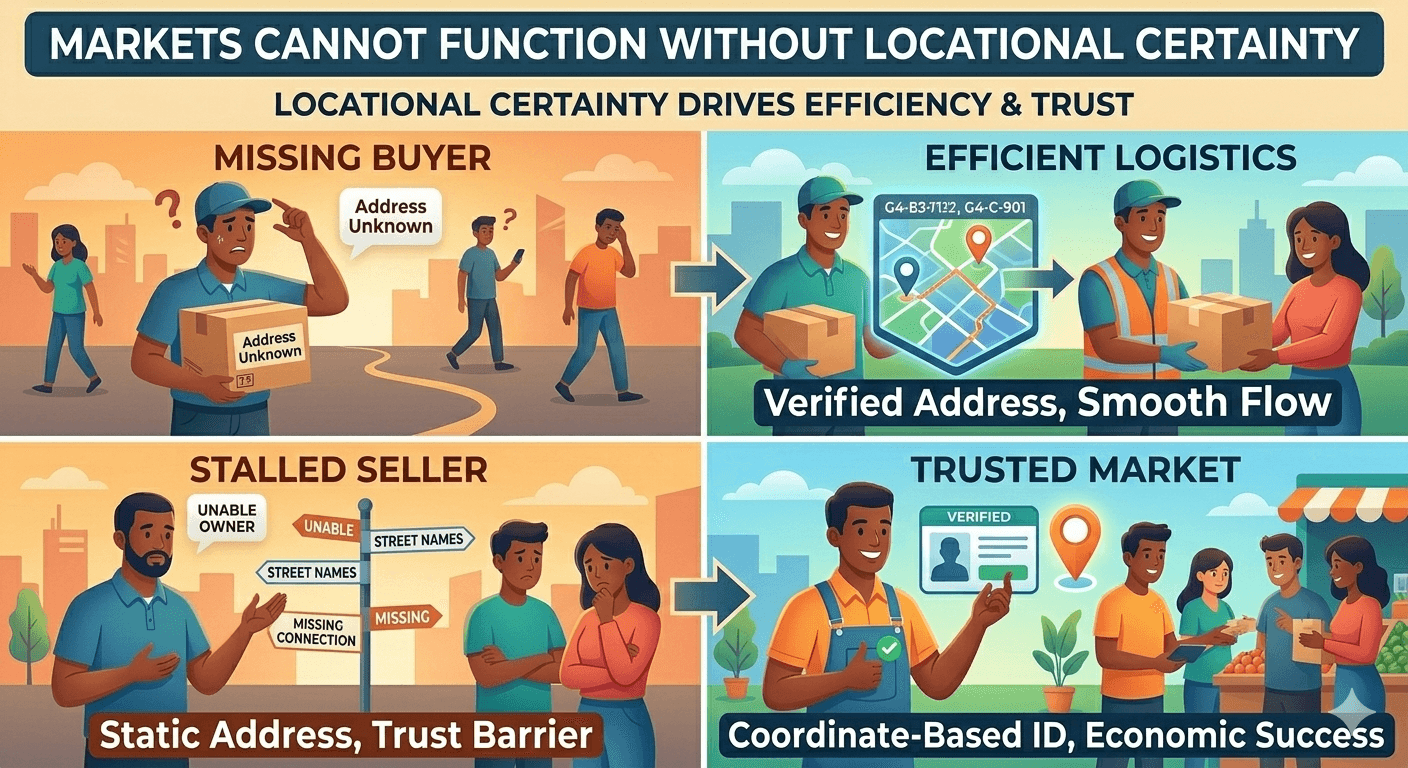
Addressing systems that do not recognize households structurally misalign infrastructure with lived economic reality.
Introduction: Infrastructure Usually Stops at the Building
When cities design infrastructure, they think in terms of roads, districts, utilities, and buildings. But economic life does not happen at the scale of the street or the block. It happens at the level of the household.
Income is earned by households. Bills are paid by households. Credit histories are built by households. Social benefits are distributed to households.
Yet in many addressing systems, the household is invisible.
Buildings Are Not Economic Units
A building may contain:
Multiple rental units
Subdivided informal apartments
Extended family households
Mixed commercial-residential occupancy
When an address references only the building, institutions cannot distinguish between economic units inside it.
This has implications for:
Utility metering and billing
Credit scoring and risk assessment
Social protection targeting
Emergency response accuracy
The OECD has emphasized that granular data improves public service targeting. Without household-level reference, granularity is compromised.
The Informal Subdivision Problem
In rapidly urbanizing regions, buildings are often subdivided without formal re-registration. A single plot number may represent five, ten, or twenty distinct households.
UN-Habitat reports that informal densification complicates municipal data systems and service provision.
If the smallest recognized administrative unit is the building, data accuracy collapses under density.
The Economic Consequences
When households are indistinguishable in administrative systems:
Tenants struggle to build independent utility histories
Financial institutions face higher verification costs
Governments experience leakage or misallocation in subsidies
World Bank research on foundational registries underscores the need for precise entity identification to enable interoperable public services.
The household is that entity.
Addressing as Micro-Infrastructure
Infrastructure is often defined as the systems that enable economic activity at scale.
If roads connect cities and grids power buildings, addressing connects households to institutions.
Recognizing the household as the smallest unit of infrastructure reframes addressing as foundational—not cosmetic.
Conclusion: Design at the Right Scale
Urban policy frequently debates macro-level investments. But economic participation is ultimately experienced at the household level.
Addressing systems that do not recognize households structurally misalign infrastructure with lived economic reality.