
Urban Density Without Address Density
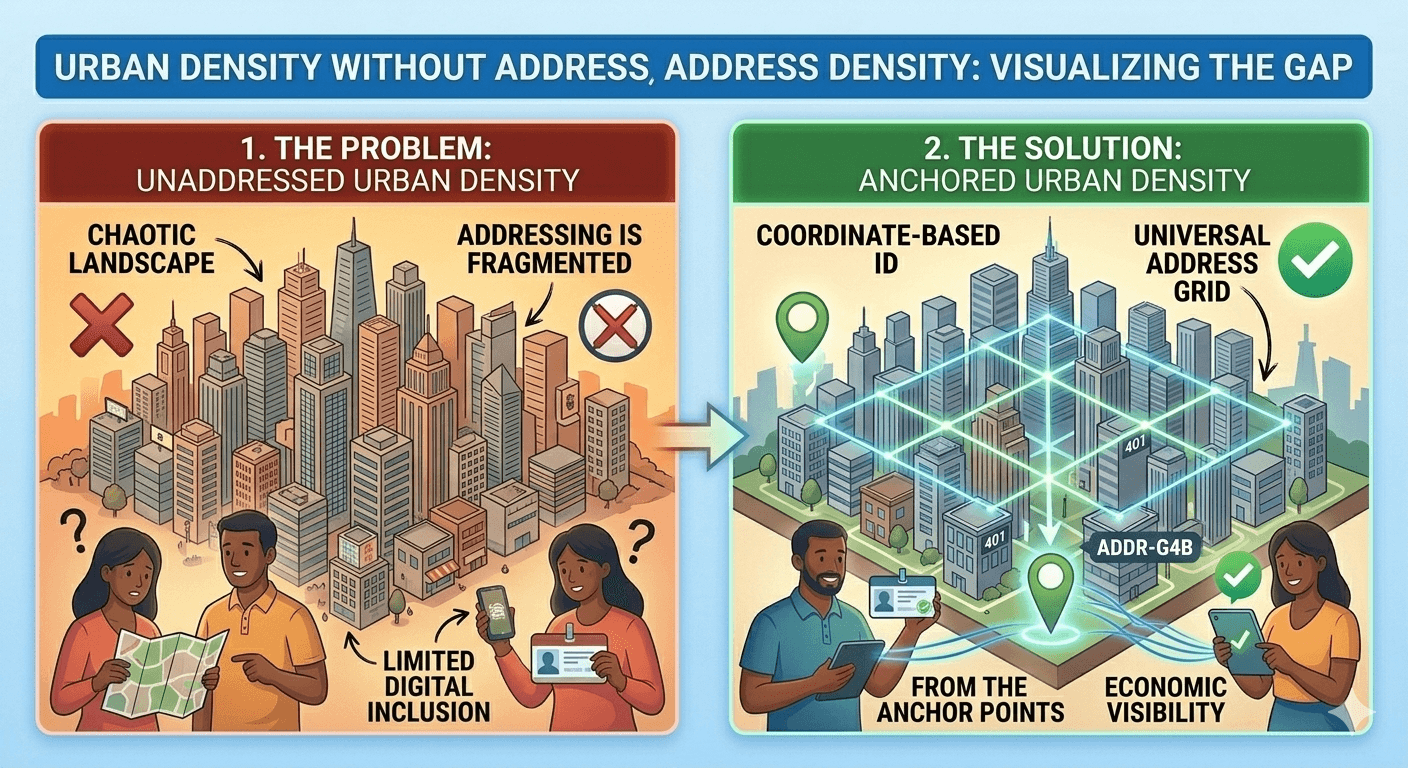
Without proportional growth in address density, administrative systems struggle to keep pace with the cities they serve.
Introduction: Density Is Not the Same as Organization
Cities are becoming denser.
The United Nations projects that urban populations will continue to expand significantly across Africa and Asia over the coming decades.
However, population density does not automatically produce address density.
Vertical Expansion and Complexity
High-rise buildings multiply households vertically. Informal subdivisions multiply them horizontally.
If addressing systems do not scale with this growth:
- Multiple households share identifiers
- Records become ambiguous
- Services become harder to target
Density without structured referencing creates administrative congestion.
Informal Urban Expansion
UN-Habitat notes that a substantial portion of urban growth occurs in informal or semi-formal settlements.
In these areas:
- Street naming may lag development
- Plot demarcation may be inconsistent
- Municipal records may be incomplete
The faster cities grow, the wider the gap can become.
Data Compression
When multiple households map to a single administrative reference:
- Economic activity is undercounted
- Infrastructure demand is underestimated
Risk assessment becomes distorted
Urban planners rely on data granularity to forecast needs. Without address density, forecasts degrade.
Delivery and Emergency Risks
In dense environments, ambiguity increases response time for:
- Ambulances
- Fire services
- Disaster relief
Logistics providers may rely on informal navigation methods, increasing inefficiency.
Density amplifies the cost of imprecision.
Conclusion: Scaling Systems with Cities
Urbanization is accelerating. Address systems must scale in precision alongside physical density.
Without proportional growth in address density, administrative systems struggle to keep pace with the cities they serve.