
If You Had to Rebuild The World's Address System Today, You Wouldn’t Start With Streets
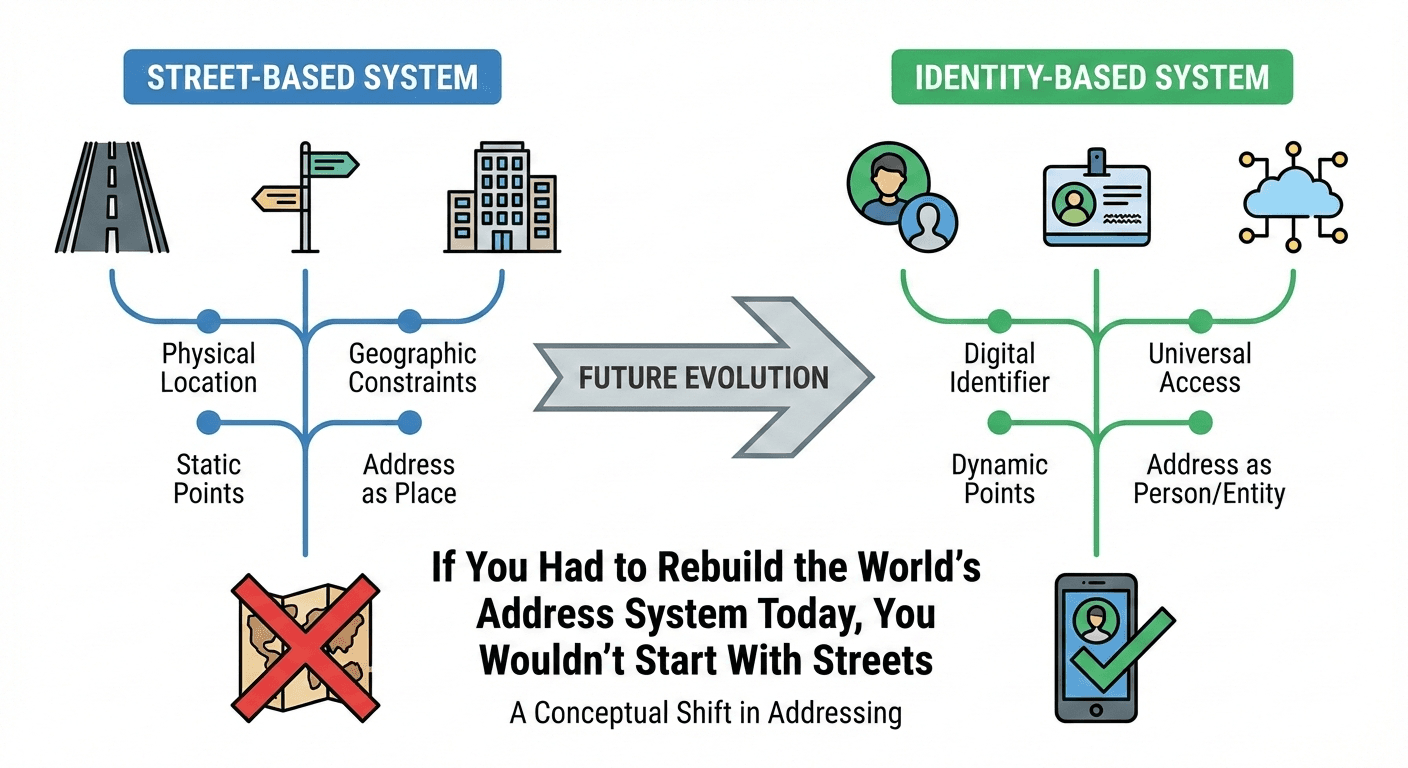
The question is not whether existing systems can be extended or digitized, but whether their foundational assumptions align with the realities of modern economies.
Modern address systems are often treated as neutral facts of urban life: streets have names, buildings have numbers, and locations are described accordingly. Yet this apparent normalcy obscures a deeper truth. Addressing is not a natural or universal construct; it is an inherited administrative system shaped by specific historical conditions that no longer define how societies function.
Street-based addressing emerged primarily in Europe between the eighteenth and nineteenth centuries alongside the expansion of postal services, census-taking, taxation, and centralized state authority. These systems assumed relatively slow urban growth, formal land tenure, and a paper-based bureaucracy capable of maintaining stable records. As historian and political scientist James C. Scott has documented, such systems were part of a broader effort by states to “see” their populations and territories in legible ways (Seeing Like a State, 1998).
Over time, this model was exported globally—often through colonial administration—becoming the default template for addressing even in contexts where its assumptions did not hold. Today, however, societies face conditions radically different from those under which address systems were first designed: rapid urbanization, informal settlement growth, high population mobility, and the digitization of economic and civic life.
This raises a fundamental question rarely asked explicitly: if the world were to design an address system today, from first principles, would streets still be the primary organizing unit?
What Address Systems Were Originally Designed to Do
To understand why this question matters, it is necessary to revisit the original purpose of address systems. Historically, addresses served a narrow set of administrative functions. They enabled mail delivery, supported taxation and conscription, and allowed governments to maintain basic population registers. The street-and-number model aligned well with these needs, particularly in cities with formal planning regimes and relatively stable populations.
These systems were not designed to support real-time service delivery, financial risk assessment, or digital identity verification. They assumed that households were fixed, land tenure was clear, and administrative updates could occur slowly without significant economic consequence.
Yet contemporary institutions now rely on addresses for far more demanding functions. Banks use them for compliance with “know your customer” (KYC) regulations. Utilities require them for service provisioning and billing. Emergency services depend on them for response coordination. Digital platforms use them to assess eligibility, manage logistics, and reduce fraud.
In effect, address systems have been repurposed as a core layer of modern economic infrastructure—without being redesigned to meet that role.
Streets as a Poor Primary Unit in High-Growth, Informal Cities
The limitations of street-based addressing become most visible in rapidly urbanizing regions. According to UN-Habitat, over one billion people currently live in informal settlements, a number projected to rise as urban growth continues to concentrate in Africa and Asia. In these contexts, streets are often unnamed, irregular, or continuously reconfigured as settlements expand incrementally.
Street-first addressing struggles under these conditions for structural reasons. Streets are linear and static constructs, while contemporary urban growth is non-linear, vertical, and adaptive. Multiple households may share a single plot. Buildings may be subdivided informally. Entire neighborhoods may emerge without formal planning approval.
As a result, attempts to retrofit street-based systems often produce partial or unstable outcomes: addresses that change frequently, fail to differentiate households, or exist only on paper. The World Bank has documented numerous national addressing initiatives that achieved limited uptake precisely because they could not accommodate informal urban realities (World Bank, Urbanization Reviews).
The issue is not implementation quality but design fit. A system optimized for planned cities with formal tenure does not translate easily to environments where informality is the dominant mode of urbanization.
Why Mapping and GPS Did Not Solve Addressing
Advances in geospatial technology have dramatically improved the ability to locate places with precision. Satellite imagery, GPS, and digital maps now cover virtually the entire planet. Yet these developments have not resolved the address problem.
The reason lies in a critical distinction: spatial precision is not the same as institutional usability. Geographic coordinates describe where something is in physical space, but addresses function as references within legal, administrative, and economic systems. They link people and households to records, rights, and obligations over time.
A GPS coordinate does not indicate who lives at a location, whether that residence is stable, or how it should be referenced across different databases. This is why, despite ubiquitous mapping, banks, governments, and service providers continue to require “proof of address” documents. Location data alone does not meet institutional requirements for persistence, interoperability, or accountability.
World Bank research on digital identification systems has repeatedly noted that foundational registries—population, civil, and location—remain essential even in highly digitized environments (World Bank ID4D Initiative). Mapping improves visibility; addressing enables recognition.
The Household, Not the Street, as the Economically Relevant Unit
At the level of economic interaction, institutions transact not with streets but with households. Access to credit, utilities, insurance, education, and healthcare is mediated through household-level relationships. Yet many address systems reference streets and buildings without reliably distinguishing individual households within them.
This mismatch has tangible consequences. Renters often lack stable addresses because they move frequently or occupy subdivided units not formally recognized. Migrants may reside in cities for years without acquiring an address that institutions accept as valid. Multi-family dwellings may share a single address, complicating service provision and risk assessment.
Research on financial inclusion consistently identifies proof of residence as a major barrier to access, particularly for low-income and mobile populations (World Bank Global Findex Database). Address instability thus reinforces broader patterns of economic exclusion, disproportionately affecting the poor, women-headed households, and recent urban migrants.
From a systems perspective, this suggests that the household—not the street—is the most relevant unit for economic and civic participation. Designing address systems around inherited spatial hierarchies rather than actual points of interaction creates persistent friction.
Institutional Costs of Designing Addressing Backwards
The consequences of misaligned address systems extend beyond individual households. At the institutional level, weak addressing undermines state capacity and market efficiency.
Governments struggle to conduct accurate censuses, plan infrastructure, or target social services when households cannot be reliably referenced. Emergency response times suffer in areas without stable addresses. Tax systems lose visibility into economic activity, reducing revenue and accountability. The OECD has linked administrative data quality directly to fiscal efficiency and policy effectiveness (OECD, Government at a Glance).
Private firms face parallel challenges. Logistics costs increase when deliveries fail. Financial institutions incur higher fraud and compliance risks. Platform businesses exclude otherwise viable customers due to address verification constraints. These costs aggregate across the economy, reducing returns on digital and physical infrastructure investments alike.
In effect, designing address systems around outdated assumptions imposes a tax on modern economic activity—one that is rarely measured but widely felt.
Conclusion: Designing from Outcomes, Not Inheritance
If addressing systems were designed today, their primary objective would not be to label streets. It would be to enable households to participate reliably in economic, civic, and digital systems. Streets might still play a role, but they would no longer be the organizing logic.
Most countries did not consciously choose their address systems; they inherited them. Inheritance, however, is not the same as suitability. As societies reassess digital public infrastructure, identity systems, and urban governance, addressing deserves the same level of first-principles scrutiny.
The question is not whether existing systems can be extended or digitized, but whether their foundational assumptions align with the realities of modern economies. Rebuilding does not require abandoning history—but it does require acknowledging that the conditions under which address systems were created no longer define the world they are now expected to serve.