
Why Governments Digitize Identity Before Fixing Location
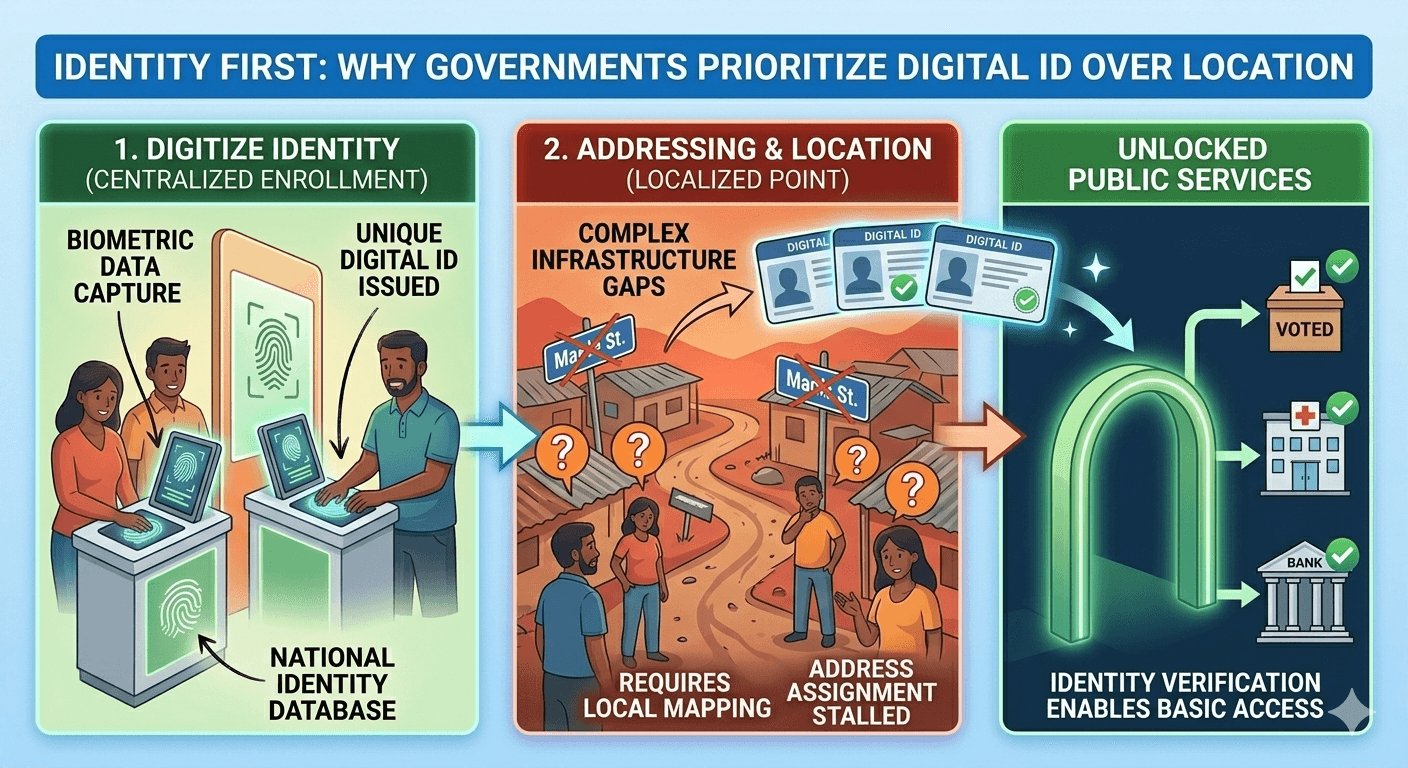
Digital identity is foundational. But without parallel modernization of location infrastructure, governments build half the architecture required for full digital interoperability.
Introduction: Identity First, Location Later
Across emerging and rapidly digitizing economies, governments have prioritized digital identity systems as a cornerstone of modernization.
Programs like India’s Aadhaar have demonstrated how large-scale biometric identity can transform access to services, subsidies, and financial inclusion.
Yet in many countries, digital identity systems have advanced faster than address systems.
Why?
The Political and Administrative Appeal of Identity
Digital identity systems offer:
- Clear enrollment metrics
- Visible modernization outcomes
- Immediate integration with banking and telecom
- Centralized administrative control
They produce tangible numbers: X million citizens enrolled, Y percent biometric coverage.
Address reform, by contrast, is:
- Spatially complex
- Politically decentralized
- Often tied to land governance
- Slower to demonstrate measurable gains
Identity is administratively attractive. Location is structurally complicated.
Identity Without Location: The Interoperability Gap
The World Bank’s ID4D initiative emphasizes that foundational registries enable service integration. But identity without precise location creates friction in:
- Service delivery logistics
- Proof-of-address verification
- Geographic targeting of subsidies
- Emergency response systems
Identity answers “Who?”
Addressing answers “Where?”
Without integration, digital government systems remain partially blind.
Land, Property, and Political Sensitivity
Address reform often intersects with:
- Land tenure disputes
- Informal settlements
- Municipal autonomy
- Property taxation systems
These are politically sensitive domains.
Digitizing identity can proceed nationally. Address reform requires coordination across municipal authorities and land registries.
Economic Implications
When identity systems mature but address systems lag:
- Financial institutions rely on workaround verification
- Logistics providers build parallel location databases
- Governments duplicate efforts across agencies
The absence of integrated location infrastructure increases systemic redundancy.
Conclusion: The Missing Half of Digital Government
Digital identity is foundational. But without parallel modernization of location infrastructure, governments build half the architecture required for full digital interoperability.
Fixing identity without fixing address leaves digital transformation incomplete.