
Why Location Is a Core Layer of Economic Identity
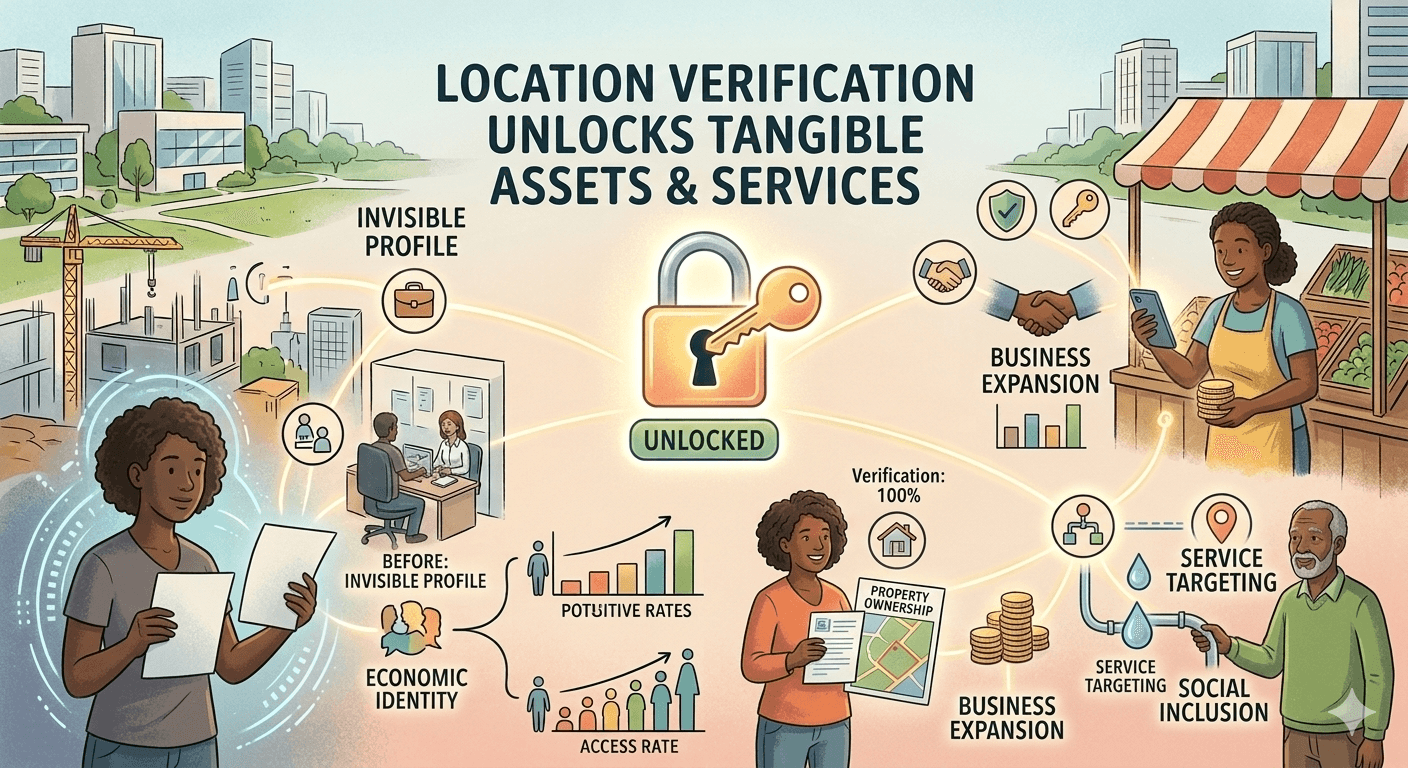
Identity answers “WHO.” Location answers “WHERE.” Economic participation requires both.
Introduction: Identity Is Multidimensional
Economic identity typically includes:
- Name
- Date of birth
- National ID number
- Contact information
But location is often treated as secondary.
In reality, it anchors identity in physical space.
Location as Verification Anchor
Institutions use location to:
- Place an individual/organization
- Assess jurisdiction
- Determine tax obligations
- Evaluate geographic risk
- Confirm service eligibility
Without reliable location data, identity remains partially abstract.
The World Bank’s ID4D program highlights that foundational systems must interact seamlessly to enable service delivery.
Location is one of those foundational layers.
Economic Behavior and Geography
Where people live influences:
- Access to jobs and opportunities
- Access to schools
- Access to public services
- Exposure to environmental risk
- Insurance premiums
Geography shapes economic opportunity.
Precise location data allows institutions to model these factors responsibly.
Persistence Over Time
An effective address system provides:
- Continuity across moves
- Historical referencing
- Structured updates
This persistence supports credit histories and administrative records.
Toward Integrated Identity Stacks
Future digital public infrastructure increasingly integrates:
- Civil registration
- Business registration
- Property records
- Address registries
- Location identification
Location is not peripheral—it is structural.
Conclusion: Completing the Identity Equation
Identity answers “WHO.”
Location answers “WHERE.”
Economic participation requires both.
Treating location as a core identity layer strengthens interoperability and inclusion.