
Why Informal Addresses Keep Families Informal
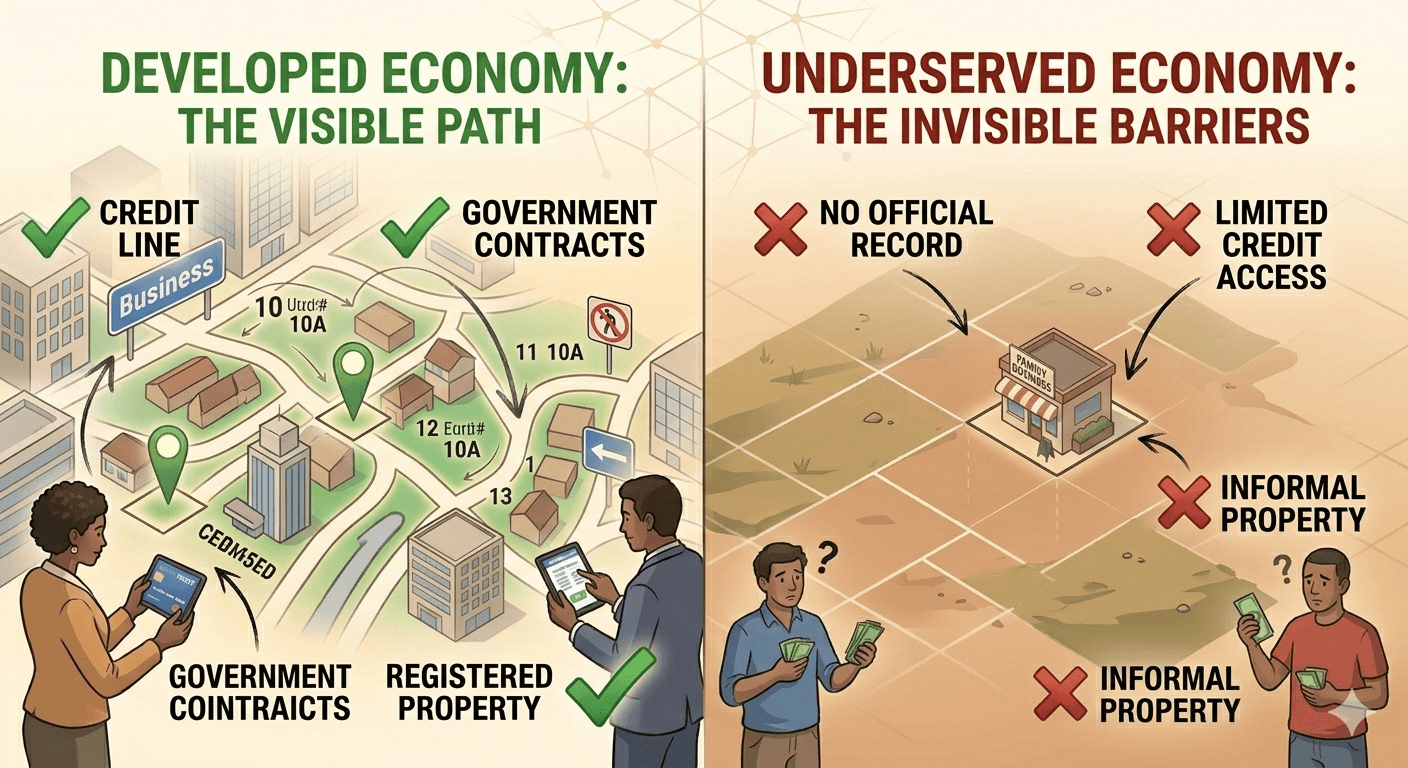
When households cannot be consistently recognized in administrative systems, their economic activity remains partially invisible.
Introduction: Informality Is Not Only About Housing
Discussions of informality typically focus on land tenure, labor markets, or small business regulation. Yet a less examined dimension of informality lies in how households are referenced within administrative systems.
In many cities, families describe where they live using landmarks, personal networks, or descriptive phrases rather than standardized addresses. These systems function socially. Neighbors understand them. Taxi drivers adapt to them.
However, institutions do not.
When location cannot be consistently recorded, verified, and shared across systems, households remain partially outside the formal economy — regardless of their income, productivity, or aspirations.
Address Informality as Structural Constraint
Informality is often treated as a behavioral issue — individuals operating outside regulation. But in many cases, the constraint is infrastructural.
If a renter cannot provide a standardized address, they may be unable to:
1. Secure bank loans
2. Participate in the global economy
3. Access public services
4. Obtain legible insurance
World Bank financial inclusion research consistently identifies documentation requirements as barriers for low-income populations. Address instability sits within this constraint.
The absence of a stable locational reference transforms otherwise formal transactions into informal ones.
Intergenerational Effects
Informality compounds over time. Children growing up in households without standardized addresses may face:
1. School enrollment difficulties
2. Limited access to formal employment verification
3. Reduced ability to establish credit histories
These effects are rarely traced back to addressing infrastructure, yet they shape long-term mobility.
UN-Habitat research on tenure security highlights the link between stable recognition of residence and intergenerational asset accumulation.
Rental Markets and Address Instability
Renters are particularly vulnerable. In high-growth cities, rental housing often exists within subdivided or informally recognized structures.
Without formal subdivision or household-level referencing, renters may:
1. Share addresses with unrelated families
2. Lack documentation linking them to a specific dwelling
3. Move frequently without continuity in. records
This instability undermines credit scoring, service eligibility, and social protection targeting.
Administrative Consequences
Governments attempting to formalize economic activity frequently encounter mismatched records due to inconsistent address data. This complicates:
1. Tax base expansion
2. Social welfare targeting
3. Urban planning
The OECD has emphasized that reliable administrative data is foundational to effective public governance. Address informality erodes that reliability.
Conclusion: Informality Is Not Merely Economic
Informality is often described as a market failure or regulatory gap. But it is also, in many cases, a locational referencing failure.
When households cannot be consistently recognized in administrative systems, their economic activity remains partially invisible.
Addressing reform, therefore, is not peripheral to formalization — it is central to it.